
HEALTH JOURNAL
How to Start Pilates at Home: Three Beginner Moves
Dr. Wei (Sean) Li · · Updated
You can begin Pilates at home with a mat, enough clear space and a few movements you can control. Start by learning a comfortable position and breathing steadily, then practice moving one part of your body without the rest following along. You do not need a reformer or a long routine to begin.
This guide is for generally healthy adults who are new to floor-based practice and can get down to the floor and back up safely. It introduces three basic movements, with smaller starting versions. It is not a rehabilitation program for pain, an injury, pregnancy or recovery after surgery.
On this page
Check your starting point
If you have a health condition, symptoms, a recent operation, are pregnant or have recently given birth, ask a healthcare professional which exercises are suitable before using a general routine. The NHS beginner Pilates guidance makes this distinction between general exercise and treatment for a particular condition.
Prepare a space where you can lie on your back and side without hitting furniture. Use a mat on a stable surface, clothes that allow movement, and keep pets and loose objects away. A folded towel can support the head comfortably. Difficulty getting to the floor calls for an appropriate starting alternative rather than struggling through the setup.
Learn the starting position first
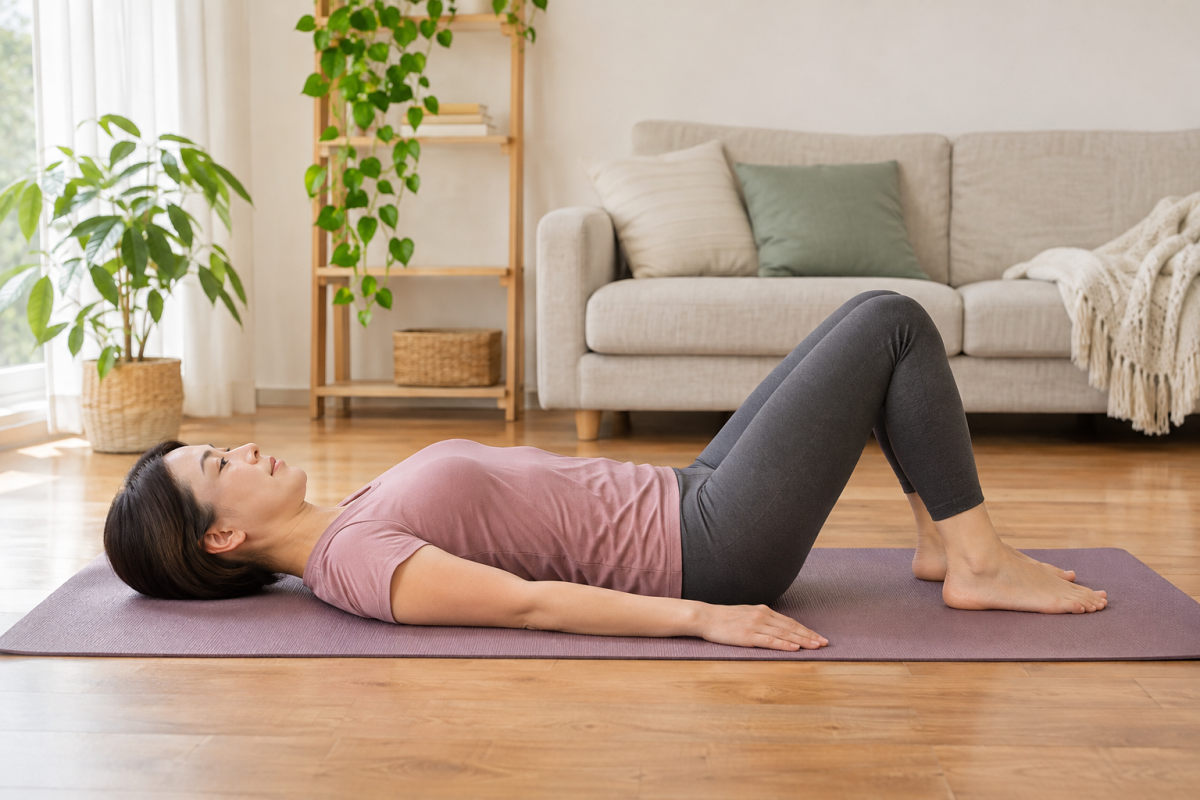
Lie on your back with your knees bent and feet resting on the mat, roughly hip-width apart. Let your arms rest beside you and relax your shoulders. Gently rock your pelvis so your lower back moves a little closer to the mat, then a little farther away. Settle around a comfortable middle position. Do not force a large arch or press your back flat as a test of doing it correctly.
Place your hands around your lower ribs. Breathe in comfortably, noticing the ribs widen to the sides; breathe out without forcing the air. Keep your neck relaxed. The aim is to coordinate breathing and movement, not hold your breath while tightening everything. These starting principles are described in Patient’s guide to Pilates at home.
For the movements below, gently draw in your lower abdomen while continuing to breathe. Think of making the movement smooth, rather than bracing as hard as possible.
Three beginner movements to practice
Learn one at a time. The knee-opening and clam examples use the basic levels in the Calderdale and Huddersfield NHS Pilates exercise booklet (pages 10 and 18). The booklet includes more advanced versions too; those are not part of this starting routine.
1. Bent-knee opening: move the leg without rolling the pelvis
- Start on your back in the position above, with both feet resting on the mat.
- Let one bent knee move slowly out to the side. Keep that foot in contact with the mat and the other knee pointing upward.
- Stop the outward movement before your pelvis starts rolling after the leg. A small opening is enough to practice this.
- Bring the knee back to its starting position with control, then try the other side.
Make it easier: reduce the distance the knee travels. If both knees move together or your waist twists, the movement is larger than you can currently control. Keeping the pelvis steady matters more than reaching the floor.
2. Small bridge: lift and lower without arching
- Lie on your back with knees bent, feet flat and hip-width apart, and arms by your sides.
- Press your heels into the mat and lift your hips a small distance. Keep your knees aligned with your feet and your hips level.
- Avoid pushing into a large lower-back arch. Keep your head resting on the mat.
- Lower your hips slowly and return to the starting position.
Make it easier: lift less high. Health and Wellbeing Queensland’s bridge instructions use this as a way to reduce the exercise’s intensity. Leave single-leg versions for later guidance; you do not need them to learn the basic movement.
3. Side-lying clam: open the knee while the hips stay stacked
- Lie on your side with your head comfortably supported. Bend your knees and keep your heels together. Position your hips one above the other.
- Keeping the heels together, slowly open the top knee upward.
- Stop before your upper hip rolls backward. The opening may be quite small.
- Lower the knee gently. When you are ready, turn over and practice on the other side.
Make it easier: use a smaller opening and keep both feet supported. You should be able to distinguish the thigh moving from the whole body rolling. Do not lift the feet or straighten the top leg to make the movement harder at this stage.
Put the movements into a manageable practice
For a first practice, choose the starting position and one movement. Try a few slow repetitions, take a break and check whether you can explain the steps without guessing. Add the other movements when their setup is clear. You do not have to finish a long follow-along class or work to exhaustion.
During each repetition, ask: can I keep breathing, return smoothly and keep the parts that should stay still reasonably steady? If the answer changes as you continue, pause. A shorter practice with understandable movements is a useful starting point; an exact session length is not the goal.
Pilates is a form of exercise. At home, it can be useful for learning controlled movement and coordinating breathing with body position. For these starter drills, choose a concrete goal, such as moving a knee while keeping the pelvis steady. Check whether that becomes smoother and easier to repeat, and whether you can progress comfortably. These observations help you judge whether your practice is serving that goal.
Use a simple note afterward: which movement you practiced, roughly how much you did, and whether anything felt painful or unclear. This gives you something concrete to discuss with an instructor. These few drills are not a complete fitness program; a balanced activity routine also needs attention to aerobic activity and muscle strengthening, as explained in the CDC’s adult activity guidance.
Know when to adjust, stop or progress
Do not push through pain or feeling unwell. Stop if an exercise causes either. Seek medical advice about persistent or concerning symptoms, rather than repeatedly trying the same movement to see whether they disappear.
If a movement is comfortable but difficult to coordinate, return to a smaller range or practice its starting position. When the basic version feels clear and remains controlled across repetitions, change one thing at a time: add a little practice, or explore a slightly larger comfortable range. Keep the simpler version available. Adding repetitions, range and difficulty together makes it harder to tell what changed.
Home practice cannot provide hands-on feedback or check a medical problem. If pain or an injury is the reason you want to exercise, a therapist-designed home exercise program serves a different purpose from this general introduction.
Get individual feedback when you need it
Individual instruction can adjust the starting position, demonstrate which areas stay steady and select a smaller version that you can control. Our private Pilates guide explains individual instruction and how it differs from a physical therapy assessment.
Wongs Acupuncture & Angel Alliance Physical Therapy offers one-to-one Medical Pilates and postural training in Manhattan and Great Neck. Contact the office to confirm the appointment format. The home practice described here is education for your own space, not an offer of home visits.
OUR LOCATIONS
Choose a clinic.
Choose a convenient location to discuss your needs or arrange a visit.