
HEALTH JOURNAL
You Do Not Have to Be Flexible to Begin Pilates
Men can start Pilates without being able to touch their toes or copy an advanced exercise. This includes someone who feels stiff after a day at a desk, someone new to exercise, and someone who already lifts weights. The starting point depends on what you can do comfortably now, your health and what you want to work toward.
Pilates teaches you to coordinate movement with breathing and to control how the body moves. An introductory session should therefore help you find a manageable way to practice, rather than require you to prove that you are flexible or strong enough to belong. A smaller, well-controlled movement can be a useful starting task.
On this page
- Why stiffness changes the starting task, rather than ruling you out
- Why an experienced lifter may still need to learn the coordination
- Separate flexibility, strength, control and endurance
- Choose mat or Reformer practice around the movement
- Fit Pilates into the activity you already do
- Know which sensations should change the plan
- Increase the challenge when the movement is repeatable
- Start with a goal that can guide an individual session
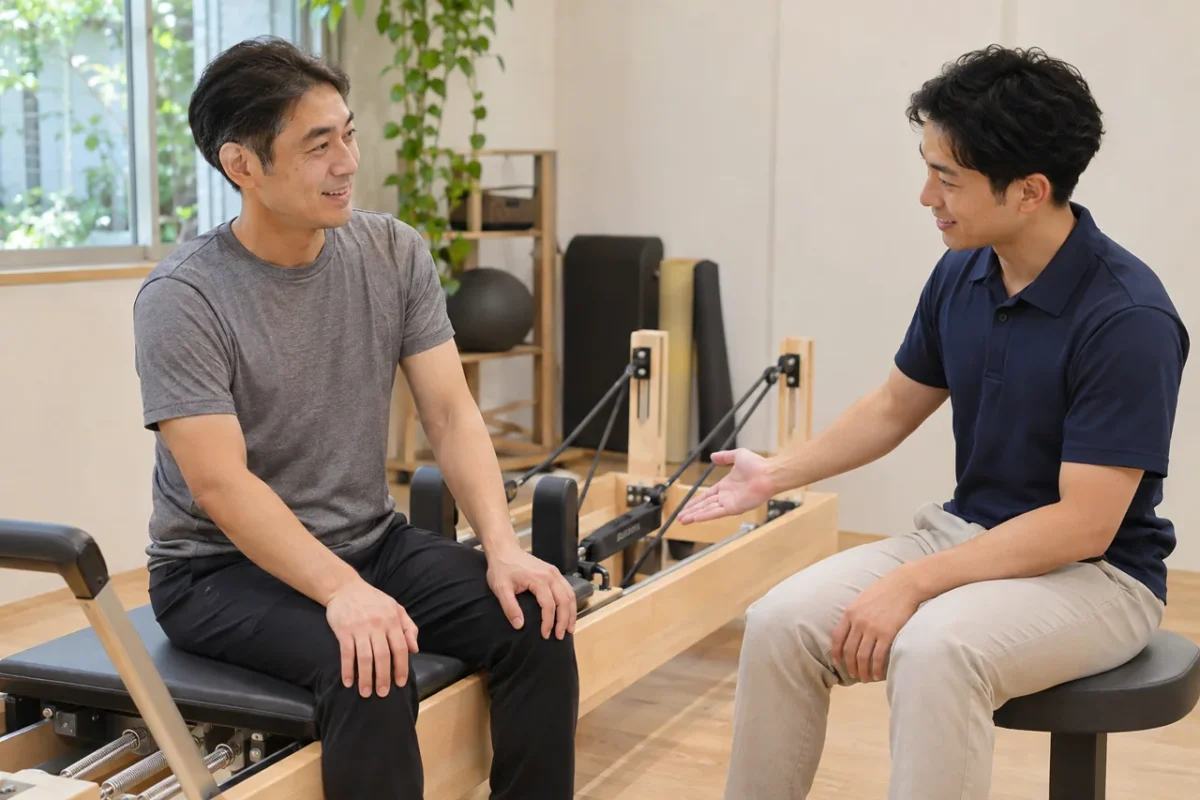
Why stiffness changes the starting task, rather than ruling you out
Flexibility affects how far you can move, but it does not decide whether you can learn. If a position is difficult, an instructor can change the position, add support or reduce the movement. This makes room to learn the task without forcing your body into the shape shown by someone more experienced.
For example, if sitting upright on the floor is uncomfortable, the first decision is whether another position or appropriate support makes the exercise more manageable. The purpose is to practice movement with less strain, not to hold the original pose at any cost.
A concrete description is more useful than saying that your whole body is inflexible. Difficulty reaching toward your shoes, turning behind you, or remaining in one position gives the instructor something specific to consider. Mayo Clinic’s introductory article similarly puts learning the basic principles before more demanding practice. Source
Why an experienced lifter may still need to learn the coordination
An exercise can be demanding because its coordination is unfamiliar, even when the resistance is modest. Slowly moving a leg while keeping the trunk steady asks something different from producing force in a familiar gym exercise. Having strength is useful, but it does not mean that you have already learned every movement task.
Breathing is part of the coordination. In STOTT PILATES teaching, the rib cage—the structure formed by the ribs—is encouraged to expand in several directions, with breathing coordinated with movement. The learning task is to keep breathing while controlling the exercise. Holding your breath or tightening the whole body continuously is a different response. Source
If you can manage the first movement only by rushing or bracing everywhere, slowing it down, reducing its range or adding support may make the task clearer. That gives you a chance to notice which part should move and which part you are trying to keep steady.
Separate flexibility, strength, control and endurance
Flexibility concerns the available movement range. Strength concerns how much force you can produce. Control concerns how deliberately you can guide a movement, including bringing it back without an unwanted shift elsewhere. Endurance concerns whether you can continue or repeat the task while maintaining the chosen quality.
These abilities help one another, but they are not interchangeable. Being strong in a squat does not tell you how comfortably you can turn. Reaching a long way does not tell you whether you can return slowly without losing control. A useful introduction identifies which part is difficult instead of treating every difficulty as a reason to push harder.
If the main difficulty is reaching into a position, a smaller range or added support may be appropriate. If the range is available but the trunk keeps shifting when a leg moves, the first emphasis may be slower control. Once the movement is familiar, repeating it without losing that control becomes another goal. These are examples of choosing a starting task, not diagnoses based on appearance.
Choose mat or Reformer practice around the movement
Mat Pilates uses body weight and body position to create the task. A Reformer has a moving carriage and adjustable springs. Its equipment changes both the resistance and the support available, so using a machine is not automatically the more advanced choice. Mayo Clinic describes the Reformer as an option for adding resistance. Source
The practical question is whether the setup lets you understand and control the movement. An instructor may change your position, support, range or resistance to find a suitable beginning. The same exercise family can therefore contain both easier and more demanding tasks; the name of the equipment alone does not tell you the difficulty.
Spring resistance also needs context. A stronger spring can make one movement more demanding while providing assistance or support in another setup. A progression is useful when it serves the movement goal, not simply because the spring feels heavier, the exercise looks impressive or the equipment costs more. Equipment and modification reference
Fit Pilates into the activity you already do
You do not have to replace walking, aerobic exercise or weight training when you begin Pilates. First decide what you want this addition to do, such as learning a new movement skill or practicing a comfortable range. That makes it easier to decide how it fits with activities you already enjoy.
For general adult health, the CDC recommends both aerobic and muscle-strengthening activity during the week. One kind of session should not be assumed to cover every goal. An individual returning after injury or surgery may need a different starting plan from these general population recommendations. Source
Consider the whole week, including work and ordinary activity. A new session still adds a demand, even when no dumbbells are involved. If you are also learning to practice at home, our Pilates at home for beginners guide addresses that separate task. This article focuses on choosing a starting level rather than supplying a home exercise sequence.
Know which sensations should change the plan
Learning an unfamiliar movement may feel effortful. That is different from sharp pain, spreading tingling, dizziness or a new loss of control. Stop the movement that brings on those symptoms and obtain appropriate assessment, rather than repeating it to see whether you can push through. NLM’s general exercise advice also emphasizes gradual progression and stopping for pain or dizziness. Source
Recent surgery, a fracture, osteoporosis and existing activity restrictions can affect the exercise and position chosen. Discuss those circumstances before starting. If pain or an injury has already changed how you move, the first task may be a clinical assessment rather than finding a harder class.
Wear comfortable clothing that allows you to move. A clothing or equipment purchase does not tell you whether the activity suits you. More useful first-session conditions are a position you can manage, instructions you understand, and room to pause or adjust the movement.
Increase the challenge when the movement is repeatable
Choose one ordinary activity that matters to you, such as putting on shoes, looking behind you or rising from a chair. Keep the comparison similar before and after practice. This helps you distinguish a change in the exercise itself from a change that is useful in daily life; it is not a promise that Pilates will resolve the difficulty.
During practice, check whether you can keep breathing, control the return and repeat the movement without creating a new painful workaround elsewhere. Afterward, consider whether the added activity fits with the rest of the day. Completing a more difficult-looking movement is less useful if its demands make ordinary activity harder to manage.
Once the current task is comfortable and repeatable, the instructor can change one demand, such as range, support, repetitions, resistance or coordination. Changing one thing makes the response easier to interpret. If the new task brings pain, breath-holding or loss of control, return to a manageable form and review the adjustment rather than treating the harder task as compulsory.
Soreness is not a required sign of successful practice. If the chosen daily task stays difficult or symptoms repeatedly increase, review the exercise, its demands and the combined activity from training, work and daily life. Persistent pain may need physical therapy assessment before further progression. The useful question is what should change in the plan, rather than simply whether you can try harder.
Start with a goal that can guide an individual session
Wongs Acupuncture & Angel Alliance Physical Therapy offers private Pilates in Manhattan and Great Neck. A useful introduction connects the movement you want to improve with the support and difficulty you need now, then identifies what to review as practice develops.
If pain or an injury is limiting movement, a physical therapy assessment can help clarify the starting plan. An acupuncture consultation can also be considered for an assessed pain concern. These are conditional care choices, not requirements for every man who wants to begin Pilates.
OUR LOCATIONS
Choose a clinic.
Choose a convenient location to discuss your needs or arrange a visit.