
HEALTH JOURNAL
When Lying on Your Side or Climbing Stairs Hurts the Outer Hip
Dr. Wei (Sean) Li · · Updated
Pain over the outer point of the hip can involve the tissues around the greater trochanter, including bursae and gluteal tendons. It is often discussed as greater trochanteric pain syndrome, or GTPS. Physical therapy begins by identifying the likely problem and adjusting aggravating pressure and activity, then rebuilding useful hip strength and walking tolerance. Not every outer-hip pain is simply an inflamed bursa. CUH gluteal tendon guide
On this page
Location helps, but does not make the diagnosis
Trochanteric bursitis can cause pain at the point of the hip, sometimes spreading along the outer thigh. Lying on the affected side, prolonged walking, stair climbing, or rising after sitting may aggravate it. These are clues rather than a home diagnosis. AAOS hip bursitis guide
A bursa is a small fluid-containing cushion that reduces friction between bone and soft tissues. The gluteal tendons attach buttock muscles to the bony point on the outer hip. Tendon and bursal problems can occur together, so treatment may need to address both pressure on the area and the muscles’ capacity to control hip loading. AAOS explains bursae; Cambridge University Hospitals explains the tendon connection.
The examination also considers the hip joint and the lower back. Groin-dominant pain, neurological symptoms, or a recent injury may change the explanation and plan. Our hip osteoarthritis and hip impingement pages address different hip problems; their exercise plans should not automatically be substituted for this one.
Reduce the pressure that repeatedly provokes symptoms
If lying directly on the painful side reliably worsens symptoms, change the sleeping setup to reduce that pressure. One option is lying on the other side with a pillow between the knees so the upper leg is supported rather than dropping across the body. Choose a comfortable arrangement you can maintain; this is symptom management, not a requirement to force one perfect posture. CUH gives position examples.
During the day, review repeated exposures such as a longer walking route or many stair trips. Temporarily reducing the provocative amount can make the rest of the plan more tolerable. Complete inactivity is not the only way to lower the load. AAOS hip bursitis guide
Build strength without chasing the sorest stretch
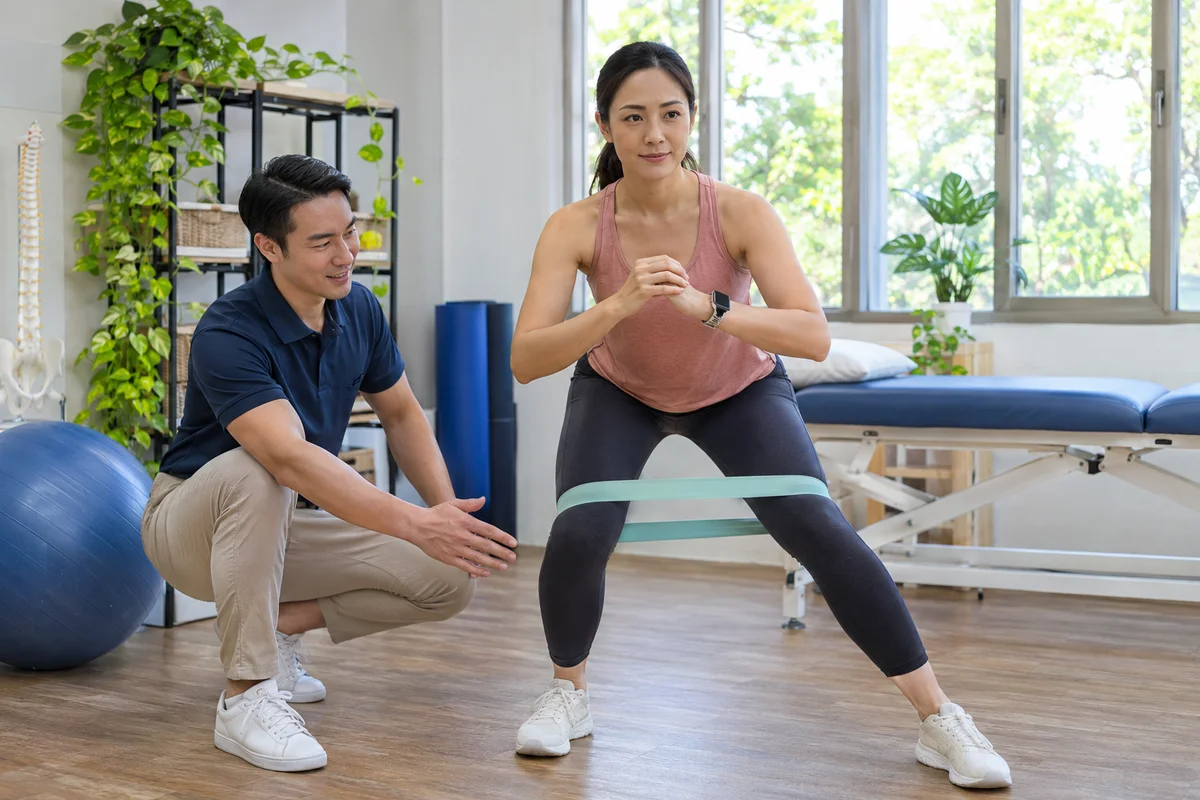
Hip strengthening needs a starting position and resistance that fit the examination. It aims to improve how the muscles support and control the hip during weight shifts and steps. Stretching mainly changes movement range; pulling the leg across the body can instead increase pressure over the sore outer hip. A feeling of tightness therefore does not automatically call for a stronger stretch. CUH explains compression and graded strengthening. Repeated sharp pain at the outer hip calls for an adjusted exercise.
An early selected exercise can use a supported sitting position, feet flat and knees hip-width apart, with the knees gently pressing outward against a suitable restraint before slowly relaxing. This practices muscle activation without a large hip movement. A therapist demonstrates the setup, checks your reproduction, and sets the resistance, hold and repetitions according to the response. CUH describes seated static activation.
The next question is functional: can you manage a controlled weight shift, rise from a chair, or walk a short route with a better response? Exercise selection should build toward those tasks. Review both what you can do and whether pain or later walking has worsened. A stronger exercise is not automatically the next step if everyday activity has become harder.
A 2018 Australian randomized trial enrolled 204 adults with persistent gluteal tendinopathy confirmed by clinical examination and a magnetic resonance imaging (MRI) scan. At eight weeks, overall improvement was reported by 51 of 66 participants assessed after education plus exercise, 38 of 65 after a corticosteroid injection, and 20 of 68 with a wait-and-see approach. At 52 weeks, education plus exercise still produced better overall improvement than injection, although pain intensity did not differ between those two groups.
This trial tested education and exercise together, with 14 physiotherapy sessions over eight weeks. That was a research schedule, not a required local appointment count. Its results support an active loading plan for the diagnosed condition rather than proving that any hip exercise, stretch or injection has the same effect.
Stairs and longer walks are later loading tasks
A short comfortable walk is different from a hilly route or repeated stair climbing. Increase the relevant demand gradually and review symptoms later as well as during the activity. Changing distance, speed, terrain, and exercise resistance all at once makes the response difficult to interpret.
Severe hip pain after a fall, inability to bear weight, or a hot swollen hip with fever needs prompt medical assessment. These symptoms should not be managed by repeatedly stretching the outer thigh. NHS hip-pain guidance
A plan for the way you move and rest
At Wongs Acupuncture & Angel Alliance Physical Therapy, physical therapy can connect the examination with practical daily mobility goals and adjustments to daily loading. An acupuncture consultation can review symptom-care options within that plan. The goal is a more manageable walk, stair task, and night's rest, rather than a promise that one treatment permanently removes every source of outer-hip pain.
OUR LOCATIONS
Choose a clinic.
Choose a convenient location to discuss your needs or arrange a visit.