
HEALTH JOURNAL
Meniscus Tears: Understanding Nonsurgical Physical Therapy
Dr. Wei (Sean) Li · · Updated
Physical therapy is an important nonsurgical option for many degenerative meniscus tears and some selected acute tears. Its purpose is to improve movement, strength and the activities your knee can tolerate. Whether it fits your injury depends on the tear, symptoms and other findings. A locked knee, a major new injury and rehabilitation after a surgical repair need different decisions.
This guide focuses on nonsurgical rehabilitation. Feeling better and proving that torn tissue has healed are different outcomes; useful progress can be measured through walking, stairs and other daily tasks.
On this page
Why do the tear type and symptoms matter?
Each knee has two menisci, wedges of cartilage between the thighbone and shinbone that help cushion the joint. A tear can follow an injury or develop in tissue that has changed over time. Its location, pattern and accompanying knee problems affect the treatment discussion.
The AAOS meniscus tear guide explains that the outer rim of each meniscus has a richer blood supply than its inner portion, which affects the tissue’s potential to heal or be repaired. A scan report saying “tear” is therefore not a complete treatment plan. Describe how symptoms began, swelling, catching or locking, and what you cannot do.
A clinical assessment connects those details with knee movement and other examination findings. Imaging can help clarify the tear and other possible causes. Knee osteoarthritis or a ligament injury may also affect the plan; these should not be treated as identical to an isolated meniscus problem.
Can PT be a reasonable alternative to immediate surgery?
The 2025 EU–US meniscus rehabilitation consensus identifies nonsurgical care, including physical therapy, as the first approach for degenerative meniscus lesions and an option for some acute tears. The type of injury matters: not every new tear should wait through the same exercise trial, particularly when symptoms or examination suggest another treatment path.
The five-year follow-up of the ESCAPE randomized trial studied 321 adults aged 45–70 with degenerative meniscus tears in the Netherlands. It compared exercise-based PT with arthroscopic partial meniscectomy, an operation that removes a damaged part rather than repairing the tear. At five years, 278 participants completed follow-up.
Across the five-year analysis, the overall difference favored surgery by 3.5 points on a 100-point patient-reported knee-function scale. Its 95% confidence interval was 0.7–6.3 points; even the upper end was below the study’s predefined 11-point margin for judging PT not meaningfully worse than surgery. This is the meaning of “noninferiority” in this trial; it describes function in the studied group, rather than proving structural healing.
The trial excluded locked knees and injuries requiring acute surgery, among other conditions. Some people initially assigned to PT later had surgery. The findings support discussing a nonsurgical starting option in an appropriate patient group; they do not promise that every person can avoid surgery or that exercise restores every tear structurally.
What should a nonsurgical PT plan address?
Start with a task that matters: walking to transport, rising from a chair or using stairs. Explain the distance, height, load and repetition. A person with persistent swelling and difficulty walking needs a different starting demand from someone who walks comfortably but struggles with a demanding work or sport task.
Rehabilitation may address knee motion, leg strength, coordination and activity tolerance. NYU Langone’s nonsurgical treatment guide describes a personalized program to rebuild strength and flexibility and return to daily activities. The exercise choice should follow the findings, rather than the word “meniscus” alone.
Which exercises, and how much?
Each exercise addresses an identified limitation, with a demonstrated starting version. Options may include selected motion work, leg strengthening and tolerated low-impact activity. Stationary cycling may fit some movement and symptom patterns; cycling, deep bending or any other movement is not suitable for every tear.
Instructions specify position, range, resistance, repetitions and frequency. The therapist demonstrates unfamiliar movements, observes you repeat them and provides an adjustment when needed. A short usable plan is more useful than conflicting exercise lists. Our home exercise guide explains recording these details.
What can selected knee-strength exercises look like?
The AAOS knee conditioning guide illustrates seated knee extension and supported partial squatting. A therapist may select an appropriate version for nonsurgical rehabilitation after examining your tear and symptoms, with a personal range, resistance, repetitions and frequency. A tear’s location alone does not determine the right movement or squat depth.
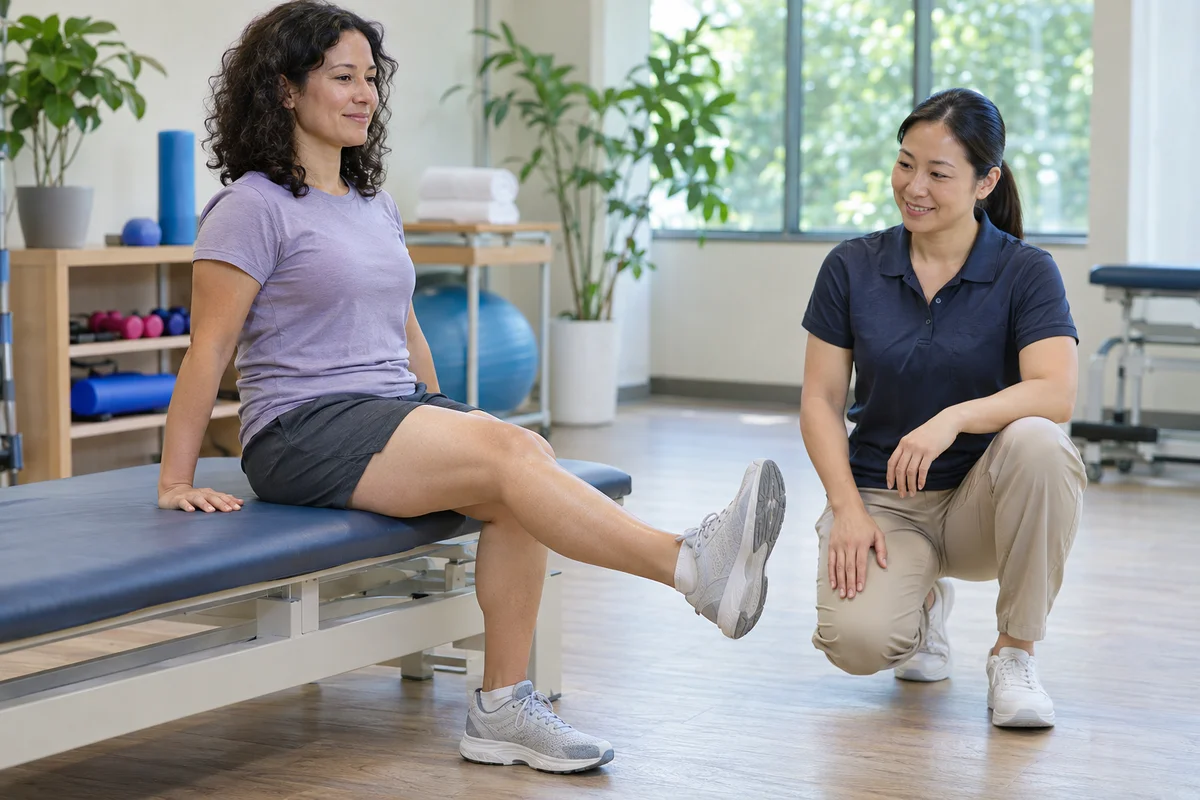
- For seated knee extension, sit upright on a chair or bench. Tighten the front of the thigh, slowly straighten the knee within the selected range, then lower the foot with control. Avoid swinging the leg; added weight comes only when appropriate.
- For a selected shallow squat, stand with feet about shoulder-width apart and hold a sturdy support if needed. Keeping your chest lifted, move the hips back and lower only to the agreed comfortable depth, as if beginning to sit. Press through the feet to return to standing. Deep bending, twisting and added loads are separate demands.
The seated exercise emphasizes thigh-muscle control with the body supported. The standing exercise practices the thigh and hip muscles working together under body weight, which is relevant to getting up from a chair. The therapist checks technique and later symptoms before increasing range or resistance; neither exercise should be used to force through locking or increasing swelling.
Can an exercise make symptoms worse?
A movement or amount that does not fit your current knee can be difficult to tolerate. Do not keep repeating an exercise that produces increasing pain, swelling or a new loss of movement simply because it appears in a rehabilitation video. Pause that version and describe what happened to the treating clinician.
A symptom flare alone does not tell you whether the tear has changed. The next decision may be to adjust the activity or reassess the knee. New locking, marked swelling or an inability to bear weight needs prompt medical assessment rather than a harder exercise. The NHS knee pain guidance also advises urgent assessment for a hot or red knee with fever.
How do you judge whether the plan is helping?
There is no single recovery date or number of visits for every tear. Agree on a review point and compare the same useful activities. The meniscus consensus recommends combining the patient’s reported experience with performance measures, rather than relying on pain alone.
| What to track | A useful example |
|---|---|
| Everyday activity | Walking distance or the support needed to rise from a chair. |
| Demand | The height of the step, load carried or number of repetitions. |
| Response | Pain, swelling, catching or movement difficulty afterward. |
| Using the plan | Which instructions are clear and which exercises remain difficult. |
Function that is not improving calls for review of the diagnosis, exercise demands or overall approach. Persistent catching, locking or other mechanical symptoms, or important activity limitations may need another orthopedic discussion. Repeating the same plan indefinitely is not the only option.
What changes after meniscus surgery?
A repair preserves and fixes torn tissue; a partial meniscectomy removes a damaged portion. Their recovery requirements differ. Bring the actual operation details, weight-bearing limits and movement instructions. Do not use another person’s start date for walking, deep bending or resistance training.
This article does not provide a repair or meniscectomy protocol. The surgeon and rehabilitation team determine how the procedure and any accompanying injuries affect progression. Our rehabilitation overview explains how those instructions connect with daily goals.
Prepare for an assessment
Explore physical therapy at Wongs Acupuncture & Angel Alliance Physical Therapy in Manhattan, Forest Hills and Great Neck. Bring reports, previous treatment information and any surgical restrictions. Allow approximately 75–90 minutes for an initial PT visit; confirm referral, authorization and insurance requirements with your chosen office.
If you want to discuss a separate pain-care option, an acupuncture consultation may be considered after assessment. It should not be presented as repairing a torn meniscus or replace evaluation of a locked or acutely swollen knee.
OUR LOCATIONS
Choose a clinic.
Choose a convenient location to discuss your needs or arrange a visit.