
HEALTH JOURNAL
Outer-Ankle Tendon Pain: Rebuild Load Without Rushing
Physical therapy for peroneal tendon pain starts with assessing the problem around the outer ankle, then rebuilding appropriate movement, strength, balance and walking. In an assessed problem suited to nonsurgical rehabilitation, the aim is to restore capacity for real loads rather than only wait for pain to settle. Sudden severe pain, new snapping or marked instability needs reassessment before being treated as routine tendonitis. Source
On this page
- Where the tendons run and why stability matters
- Repeated load and sudden injury need different starting decisions
- Assessment links the painful tissue with the task
- Use protection to make the right activity possible
- Restore mobility without borrowing another tendon’s exercise
- Strength training rebuilds capacity for repeated use
- Balance and coordination prepare the next walking demand
- Build endurance and review the whole day’s load
- When the plan needs medical review instead
- Arrange PT around the assessed tendon problem
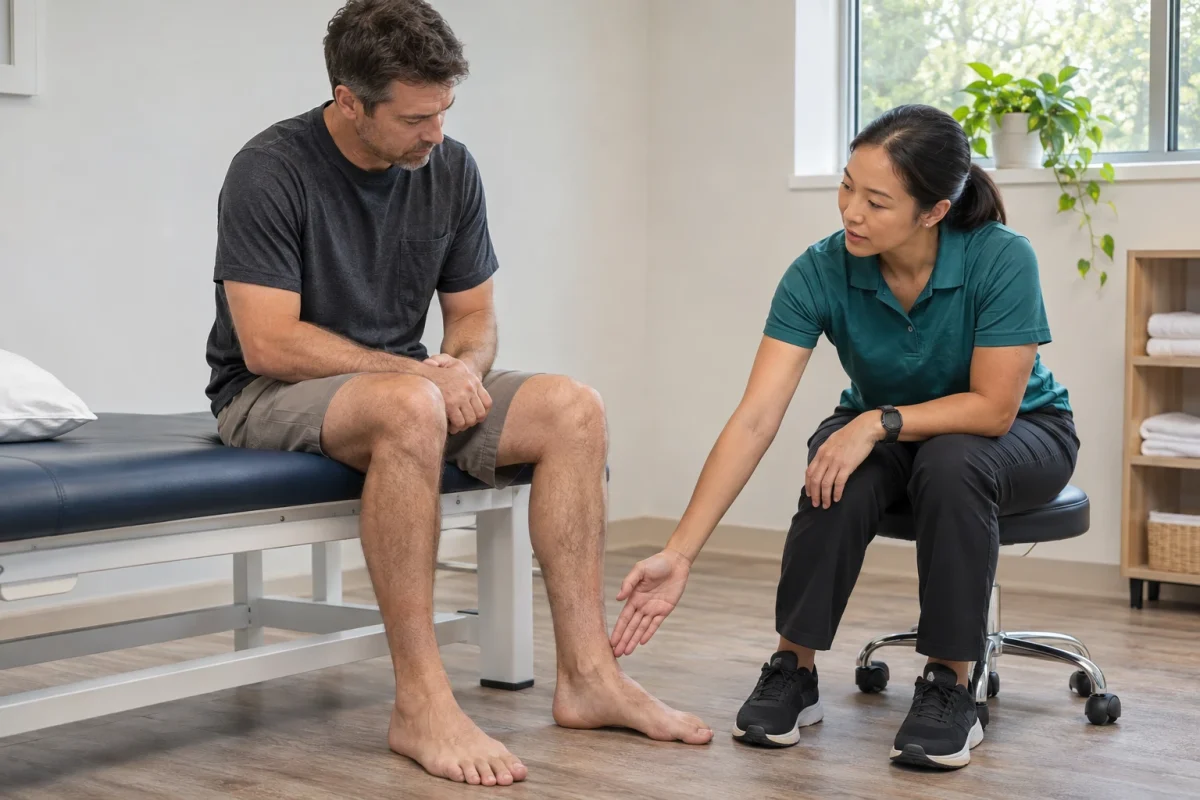
Where the tendons run and why stability matters
A tendon connects muscle to bone. The two peroneal tendons travel behind the outer ankle bone: one attaches toward the outer midfoot, while the other continues under the foot toward the inner arch. They transmit the action of muscles in the outer lower leg and help stabilize the foot and ankle, including during single-leg support or uneven-ground walking. Peroneal tendon anatomy
This explains why a flat indoor walk can feel different from a sloping trail or repeated changes of direction. A tendon problem is also different from a ligament sprain: tendons transmit muscle force, while ligaments connect bones and help support a joint. Both can be injured in the same ankle event, so one label should not automatically stand for the other.
Repeated load and sudden injury need different starting decisions
A sudden increase in running, walking, standing or uneven-ground activity may raise demands beyond what the tendon currently tolerates. Recovery time between demanding activities matters as well as the exercise session itself. Inflammation or swelling of the tendon or its surrounding sheath can also make normal gliding more difficult. Source
A tear means tendon fibers are damaged; subluxation means a tendon slips out of its normal position behind the ankle. The American College of Foot and Ankle Surgeons (ACFAS) describes new snapping, pain and instability as reasons for prompt assessment, because repeated slipping can damage the tendon further. These are not problems to diagnose by repeatedly reproducing a snap at home. Injury types and warning symptoms
Assessment links the painful tissue with the task
Assessment considers how symptoms began, changes in activity, footwear and surfaces, previous sprains and current walking or sport demands. Examination may check tenderness, swelling, ankle range, strength and stability, as well as the way you walk. The findings help distinguish tendon symptoms from fracture, arthritis or another soft-tissue injury. Source
Imaging may be needed for a suspected bone injury, tear or other problem, but the painful location alone does not select one scan or one loading program. A useful goal is specific: a comfortable commute, a stable step on uneven ground or returning to a sport. Those tasks require different starting capacities and later progressions.
Use protection to make the right activity possible
Temporarily reducing the activities that repeatedly aggravate the tendon may help establish a manageable starting level. Some people need a brace or walking boot; its movement and weight-bearing instructions take priority over a generic exercise routine. Do not stop prescribed protection because a video begins with standing exercises. Source
Footwear and the day’s total walking or standing should be reviewed together. A supportive, comfortable shoe may help, but a new insert or arch change is not automatically right for every foot. Protection should connect to a plan for appropriate movement and graded capacity, rather than becoming indefinite avoidance of all activity. Footwear and pacing context
Restore mobility without borrowing another tendon’s exercise
When appropriate, mobility work aims to restore the ankle or foot movement that is limiting a task, using a supported position and suitable range. A stiff ankle and an unstable tendon do not have the same problem, so the direction and amount should follow the assessment. More stretching force is not automatically the next step.
Position can change tendon compression. Kent Community Health, part of England’s National Health Service (NHS), cautions against doing its peroneal exercise program on a step because that can increase compression against the outer ankle bone. A familiar deep step-edge stretch from another tendon program should therefore not be copied without checking its suitability. Movement and compression advice
Strength training rebuilds capacity for repeated use
Strength work aims to rebuild the ability to control the foot and tolerate repeated daily loads. Depending on the findings, resisted outward foot movement may be selected to load the peroneal muscles, with attention to moving the foot rather than rotating the whole leg. It is an assessed exercise choice, not a required first-day self-test. Resisted movement context
The therapist can adjust support, movement range, resistance, speed and repetitions. Other ankle, calf or leg capacities may also matter for the chosen task. Progress should preserve control and be reviewed against pain and swelling during and after the exercise, rather than simultaneously increasing every variable or pushing through a new sharp pain. Reduced resting pain alone does not establish full tendon capacity.
Balance and coordination prepare the next walking demand
Balance and coordination concern how the foot and ankle respond as weight shifts or the surface changes. Depending on the assessment, practice may begin with supported standing or controlled stepping before later single-leg or uneven-ground tasks. Those tasks place different demands on stability; none is a universal starting test.
The goal is a steadier step and control appropriate to the task, not simply enduring a balance challenge until the ankle gives way. The ACFAS guide includes strength, movement and balance within rehabilitation as symptoms improve. If an ankle sprain is also present, its protection and rehabilitation needs must be considered alongside the tendon findings. Rehabilitation context
Build endurance and review the whole day’s load
A short level walk differs from a long commute, a slope, a sprint or a cutting movement. Build the relevant walking time or distance in manageable steps, counting work, errands and exercise together. Avoid adding distance, speed and uneven surfaces at the same time, so that any setback can be linked to the change.
Review the same task’s pain, swelling, walking pattern, stability and confidence, including the later or next-day response. Persistent worsening, renewed giving-way or a new snapping sensation calls for reassessment. Recovery may take longer when another injury is involved, and can sometimes extend over months; a calendar date or less pain alone is not clearance for sprinting, cutting or sport. Source Recovery and activity review
When the plan needs medical review instead
Inability to walk or bear weight, a new snapping or popping sensation, sudden severe pain or marked instability needs prompt medical assessment. Do not keep repeating resisted movements or single-leg balance to see whether it settles. These symptoms can require a different diagnosis and protection plan. Source
After a tendon repair, the surgeon’s specific movement, support and loading instructions govern progression. A nonsurgical tendon-pain program is not the postoperative plan. Return to demanding activity should follow the repair and follow-up findings, not a routine recovery date from a general tendonitis page.
Arrange PT around the assessed tendon problem
Our ankle sprain rehabilitation guide addresses a related but different injury. Wongs Acupuncture & Angel Alliance Physical Therapy offers physical therapy in Manhattan, Forest Hills and Great Neck. Explain the activity change, current support instructions and daily or sport task you want to regain so the plan can connect protection, movement, strength, control and endurance.
An acupuncture consultation can be considered separately for an assessed pain concern; it does not replace evaluation for a tear or slipping tendon, or change postoperative restrictions.
OUR LOCATIONS
Choose a clinic.
Choose a convenient location to discuss your needs or arrange a visit.