
HEALTH JOURNAL
Endometriosis Symptoms: Pain, Evaluation and Supportive Care
Ben Wong · · Updated
Progressively painful periods, pain with sex or bowel movements and persistent pelvic pain deserve gynecologic assessment. Endometriosis is one possible cause. A complementary visit can discuss accompanying symptoms, but it should not be advertised as removing lesions or replacing indicated medical care.
Painful periods can be dismissed as something to endure even when they affect work, relationships, emotional wellbeing or pregnancy planning. Progressive pain and cyclical bowel, bladder or sexual symptoms deserve assessment. Baylor College of Medicine’s explanation of ACOG’s 2026 guidance describes earlier clinical recognition and treatment rather than a requirement to wait for diagnostic surgery before any care can begin.
On this page
- What is endometriosis?
- What do patients usually notice?
- Why is this not only a pain problem?
- What does modern medicine focus on?
- How might TCM look at this pattern?
- Define the purpose of a supportive consultation
- When should gynecologic review come first?
- Make the impact visible
- Coordinate goals across services
- What a normal scan can and cannot resolve
- Keep a symptom record connected to daily life
- Explain how pregnancy priorities affect the plan
- Bring all care changes to the review
- Understanding the actual expertise being offered
- Common questions
- Appointments and practical arrangements
- Sources and further reading
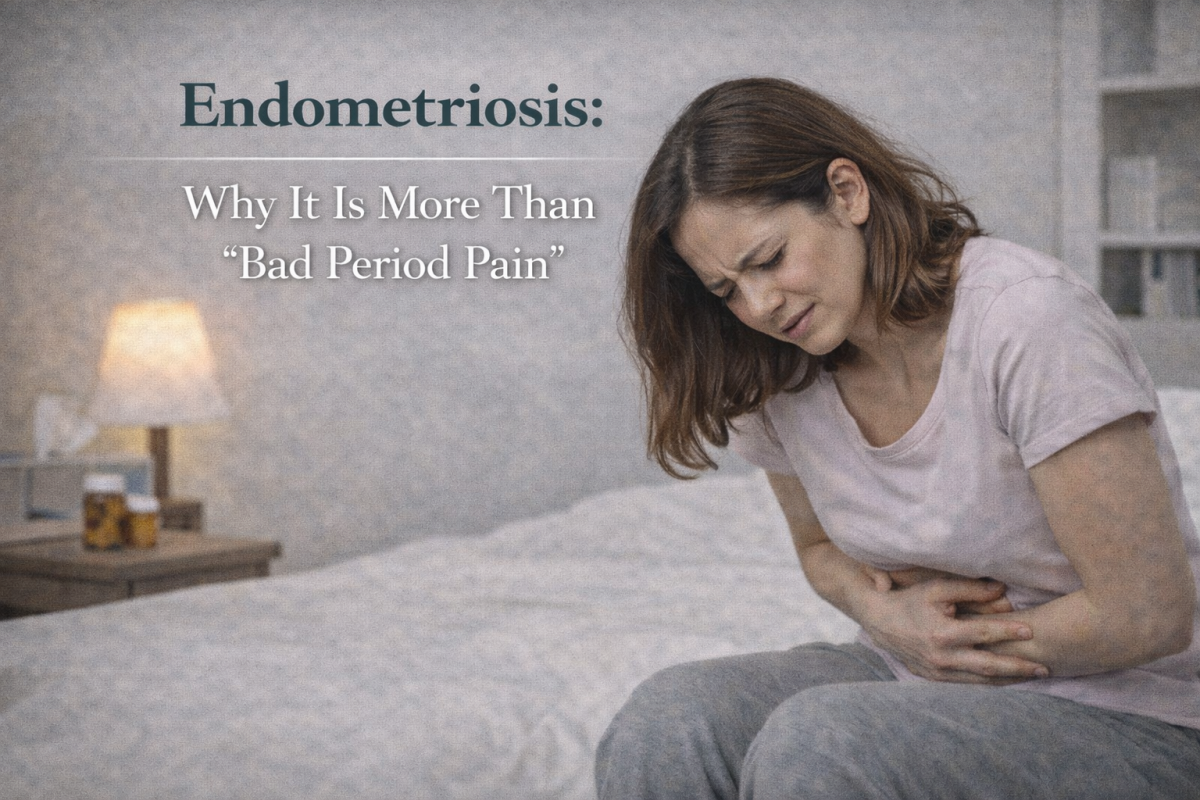
What is endometriosis?
Endometriosis is a chronic condition in which tissue similar to the uterine lining grows outside the uterus. It can involve the ovaries, pelvic lining, tissues supporting the uterus, bowel or bladder. NICHD’s overview explains these locations. “Similar to” matters: the condition is not simply a normal period occurring in the wrong place.
Lesions can respond to hormones, with local bleeding or inflammation and chemicals that irritate surrounding tissues. Scarring can bind pelvic structures together; altered nerve sensitivity can also contribute to pain. NICHD’s pain explanation describes these mechanisms. Pain severity does not reliably show the amount of disease, and less pain does not prove lesions have disappeared.
For patients, the most important meaning of that definition is this: the issue is not simply one painful day each month. For many people, the pain slowly spreads into a broader pattern that affects the days before menstruation, the days after, sexual comfort, bowel function, energy, and confidence around conception.
What do patients usually notice?
People may describe the problem in everyday language:
- My period pain keeps getting worse
- I need more medication than I used to
- sex is starting to hurt
- Bowel movements are painful during my cycle
- I feel pelvic pain even outside the period
- Every period leaves me exhausted
- I have been trying to conceive, but something feels off
NICHD’s symptom information includes worsening menstrual cramps, pain during or after sex, pain with bowel movements or urination around periods, fatigue and difficulty conceiving. These are reasons to investigate, not a checklist that diagnoses endometriosis by itself.
Why is this not only a pain problem?
One reason endometriosis gets minimized is that many patients can still “push through.” But the clinical burden is often larger than pain alone. It may affect work, sleep, intimate relationships, mood, energy, and fertility planning.
A complete plan considers the symptom burden, daily tasks, sleep, sexual comfort, emotional needs and whether pregnancy is a priority. Being able to push through an activity does not mean the problem has been adequately addressed.
Pain management and fertility treatment can require different choices. Hormonal suppression may help pain but usually does not serve someone who is actively trying to conceive. NICHD’s treatment overview explains why these goals and their timing need to be discussed separately.
What does modern medicine focus on?
Evaluation and treatment are planned together:
The gynecologic team reviews symptoms, their daily impact, examination findings and pregnancy priorities, then selects imaging or specialist referral as appropriate. Ultrasound can help identify an ovarian endometrioma or deep disease; a normal result cannot settle every case. According to the 2026 guidance explained by Baylor, a clinical assessment can support starting medical treatment while evaluation continues. Laparoscopy remains an option to confirm and sometimes treat disease; it is not required before every person can begin symptom care.
Medical options have different purposes. A nonsteroidal anti-inflammatory drug (NSAID) may be considered for symptom relief after reviewing personal risks. Hormonal treatments, including contraceptive or progestin-based options and selected medicines that modify reproductive-hormone signals through the GnRH pathway, reduce cyclical stimulation or suppress symptoms; their effects, side effects and pregnancy implications differ. Surgery may remove or destroy selected lesions or address adhesions. NICHD’s overview discusses these roles and the possibility of symptoms returning; none makes improvement in pain a test that the disease has been cured.
Surgical decisions should account for disease location, organs involved, prior treatment and reproductive goals. Surgery involving ovarian endometriomas, especially repeated procedures, may affect ovarian function. Someone trying to conceive needs discussion of fertility evaluation, surgery and assisted reproduction when relevant, rather than using hormone suppression as a fertility treatment or assuming every cyst requires the same operation.
How might TCM look at this pattern?
In TCM, “stasis” describes obstruction or poor movement of Blood within the traditional framework. Fixed or stabbing pain and clot-related observations may be part of that assessment; it is not a measurement of a blocked vessel or the amount of endometriosis. Guang’anmen Hospital’s endometriosis teaching (Chinese) explains four common pattern families and different traditional goals.
Qi stagnation with Blood stasis may include premenstrual breast distension, lower-abdominal stabbing pain and dark clots, considered with the whole history. The traditional goal is to ease Qi constraint and improve Blood movement. Emotional changes can be part of the history, but they do not establish that worry caused the disease.
Cold congealing with Blood stasis emphasizes a cold lower-abdominal pain pattern, cold hands or feet and preference for warmth. The traditional aim is to warm and disperse Cold while addressing stasis. Feeling better with warmth is one observation, not a diagnosis or a reason to keep increasing heat on an unexplained painful area.
Damp-Heat with stasis may involve menstrual abdominal pain together with thick yellow discharge or a bitter taste in the mouth. The traditional goal differs: clearing Heat, resolving Dampness and addressing stasis. New discharge, fever, feeling unwell or new severe pain requires medical assessment; it should not simply be assigned a traditional label and treated as a routine appointment.
Kidney deficiency with Blood stasis combines reduced traditional support with obstruction. Low-back or knee aching and pain around or after menstruation may be considered in context; the traditional aim is to support that function while addressing stasis. “Kidney” here is a reproductive-support concept within TCM, not anatomical kidney disease or a test of fertility.
Patterns can overlap, and weakness may coexist with obstruction. Fatigue, poor sleep, reduced flow or slower recovery need to be considered with menstrual history, medicines, tongue and pulse rather than forced into one label. The practitioner should explain the current priority and how it will be reviewed as symptoms, bleeding or the medical plan changes. A traditional pattern does not determine lesion size or replace investigation of a new symptom.
Define the purpose of a supportive consultation
If considering acupuncture, bring the gynecologic diagnosis, current medicines and treatment restrictions. Agree on a specific pain or accompanying-symptom goal, proposed body areas, positioning, comfort and how to pause. The first-visit guide explains the consultation process. Review the same activity or symptom and how long any improvement lasts, keeping it separate from lesion removal or fertility claims.
A 2023 randomized trial assigned 106 women aged 20–40 at four hospitals in China to acupuncture or sham for 12 weeks, followed by another 12 weeks of observation. At week 12, acupuncture produced greater improvement in menstrual-pain scores and several wellbeing measures, and a shorter pain duration. At week 24, the between-group differences in pain scores and wellbeing measures were not statistically significant. Changes in nonmenstrual pelvic pain and pain with sex also did not differ significantly between the groups. These results concern specific symptoms and time points, not removal of lesions or a higher chance of conception.
Herbal products require a separate ingredient and interaction review, especially when medicines or fertility treatment are involved. A traditional pattern description can explain the practitioner's reasoning, but it should not be treated as a measurement of lesions or a replacement for gynecologic assessment.
When should gynecologic review come first?
Progressively worsening period pain, increasing pain with sex or bowel movements, pain outside the period, substantial fatigue or affected pregnancy plans warrant gynecologic review. An additional consultation may discuss an assessed accompanying concern alongside that work, but it should not become the step that must happen before necessary medical evaluation.
Often, what these patients need most is not more endurance. It is a clearer picture.
Endometriosis is often delayed because it gets minimized as “just bad periods.” A safer approach is to take it seriously once symptoms start affecting daily life, sexual comfort, emotional resilience, or fertility timing.
When symptoms begin to determine work, sleep, sexual comfort or daily plans, make their impact clear to the gynecologic team. You do not have to keep enduring them or identify the cause yourself before seeking help.
Make the impact visible
Record pain timing, bleeding, bowel or bladder symptoms and the activities you miss. Include fertility goals, prior imaging, surgery and treatments tried. The severity of symptoms alone does not establish the extent of disease.
Coordinate goals across services
Each service should have a distinct task. Acupuncture, if chosen, has an assessed symptom goal and a review point. A pelvic-health physical therapist may assess a coexisting muscle or movement component, such as tenderness, excessive tension, weakness or coordination problems. APTA Pelvic Health’s explanation describes individualized hands-on care, movement, breathing and relaxation or other targeted exercises. A tight, painful muscle may need a different goal from a weak one; a generic strengthening routine is not automatically appropriate.
PT aims at muscle function and daily activity, not removal of endometriosis lesions. The team can compare a relevant task such as sitting or walking, then adjust the practice plan. A general PT service listing does not establish that a particular pelvic-health specialty is available. Coordinate any needed specialist care through the medical plan; do not infer it from a service link alone.
What a normal scan can and cannot resolve
A scan may help the gynecologic team investigate an endometrioma, deeper disease or another explanation for symptoms. The result needs to be interpreted alongside the history and examination.
NICE endometriosis guidance explains that a normal examination or ultrasound does not exclude endometriosis and that further referral may still be appropriate. If pain continues to interfere with daily life, bring that impact back to the clinician rather than concluding that a normal scan means the symptoms do not matter.
Keep a symptom record connected to daily life
Record where discomfort occurs, whether it follows the cycle and which tasks it affects. Include pain with bowel movements, urination or sex when relevant. Note what you tried and whether it was useful. You do not need to identify the involved structure or assign every sensation to a particular lesion before seeking help.
Choose a format you can maintain without spending the whole day monitoring symptoms. A short calendar entry and an example of an affected activity can make a follow-up more focused. Distinguish a change in pain from a change in bleeding or another symptom so the clinician can consider each concern appropriately.
Explain how pregnancy priorities affect the plan
Tell the gynecologic team whether pregnancy is a current goal, a future possibility or not part of your plans. That context matters when discussing treatment options and their timing.
If fertility evaluation is indicated, do not create a waiting period to complete complementary appointments first. Bring the reproductive plan to any additional consultation. Our fertility-evaluation article explains general timing considerations without assuming that endometriosis is the only factor that needs investigation.
Bring all care changes to the review
Include medicines, procedures, exercise advice and any product you have added since the previous visit. This can help prevent conflicting instructions or a useful observation being lost between appointments.
A pain-focused review should consider what you can do, how long relief lasts and whether the plan is manageable. If symptoms change or the current approach is not helping sufficiently, return to the clinician coordinating the medical plan. An optional service should remain responsive to that review. New severe pain, significant bleeding or another serious symptom needs timely medical assessment rather than a routine complementary visit.
Understanding the actual expertise being offered
Services with similar names may involve different skills. A general physical therapy listing should not be interpreted as confirmation of a particular pelvic-health service.
A clear explanation of the service is more useful than a package offered solely because the diagnosis appears in its name.
Common questions
Does severe period pain always mean endometriosis?
No. Severe pain has more than one possible cause. Progressively worsening pain, pain with sex or bowel movements, chronic pelvic pain, fatigue or difficulty conceiving needs closer assessment rather than dismissal as ordinary cramps.
Can endometriosis affect fertility?
Yes, although not everyone develops infertility. Pelvic tissue changes and other reproductive factors need assessment. When pregnancy is a current goal, the pain plan and reproductive plan should be considered together.
Can supportive care be discussed after diagnosis?
Yes, for an assessed accompanying concern, with a defined role and review point alongside gynecologic care. Describe pain, exhaustion, sleep difficulty or recovery separately; do not assume one service treats every problem.
Can acupuncture remove endometriosis?
It should not be presented as removing lesions or guaranteeing conception. A consultation may discuss an assessed symptom goal alongside the medical plan. Less pain does not prove that disease is gone.
When should I stop simply tolerating pain?
Worsening pain, less relief from the existing plan, increasing sexual or bowel pain, pain outside periods or affected pregnancy plans call for medical review. New severe pain or significant bleeding needs timely assessment.
What if pain is my main concern, rather than fertility?
Pain affecting work, sleep, energy or daily life is a meaningful reason to seek care. Describe the activity affected and the pattern; pregnancy need not be the main goal.
If menstrual, sexual or bowel pain is increasing, arrange appropriate gynecologic assessment and explain the impact on daily life or pregnancy plans. If you also want to discuss acupuncture, use the clinic cards below and bring the medical plan so the optional visit can fit it.
Appointments and practical arrangements
Can less pain establish that endometriosis has disappeared?
No. Symptom response and the underlying disease are different. Continue the recommended medical follow-up.
Sources and further reading
OUR LOCATIONS
Choose a clinic.
Choose a convenient location to discuss your needs or arrange a visit.