
HEALTH JOURNAL
When to Seek Fertility Evaluation: Age, Timing and Risk Factors
Ben Wong · · Updated
Fertility evaluation is generally considered after 12 months of trying when the female partner is under 35, after 6 months at 35 or older, and sooner over 40 or when risk factors are present. The appropriate timeline depends on both partners and their medical history.
Many patients who ask fertility-related questions are not only worried about why pregnancy has not happened. They are also concerned about fertility evaluation timing. Am I coming too early? Have I already waited too long? Should I keep trying on my own, or is this the point where a clearer evaluation is needed?
This anxiety is common and understandable. Trying to conceive is not only a biological issue—it is closely connected to time, physical resilience, age, relationship stress, and uncertainty about the next step. Understanding proper fertility evaluation timing helps patients move beyond guesswork and make more informed, confident decisions about when to seek support.
On this page
- When does trying usually become a reason for evaluation?
- Why shouldn’t everyone just “wait a year”
- Why age keeps coming up
- What happens at this stage in a TCM clinic?
- Who should seek medical advice earlier?
- Organize the first medical conversation
- Keep complementary care on the same calendar
- What the first reproductive evaluation is trying to establish
- Prepare a timeline that makes the consultation easier
- Leave the visit knowing the next step
- Revisit timing when circumstances change
- Common questions
- Appointments and practical arrangements
- Sources and further reading
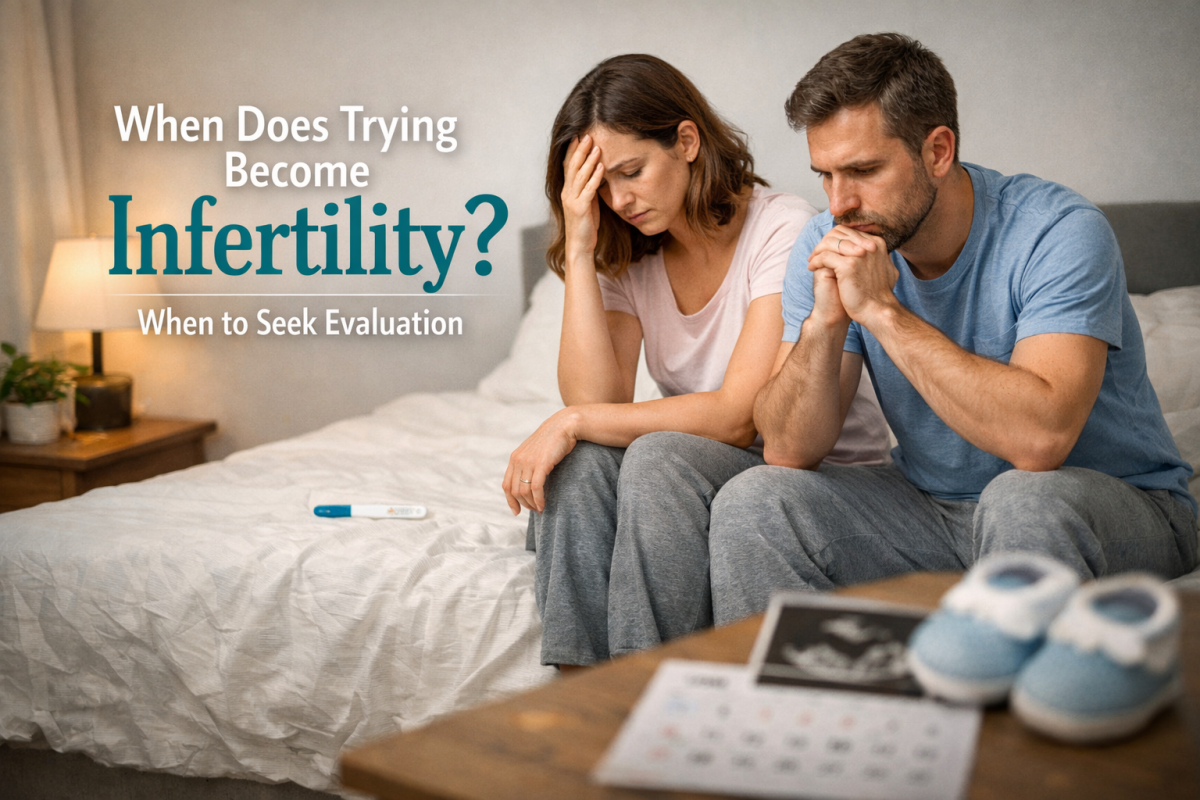
When does trying usually become a reason for evaluation?
In general, the usual timing is understood like this:
The 2026 ASRM guidance recommends starting evaluation after 12 months of regular unprotected intercourse without conception when the female partner is under 35, or after 6 months at 35 or older, if neither partner has a known reason for earlier investigation. Above 40, more immediate evaluation may be appropriate. Known risk factors can justify assessment without waiting for those intervals.
The important point is not memorizing a number. The point is to understand that these timeframes are meant to prevent the loss of time, not to stop people from asking questions earlier.
Why shouldn’t everyone just “wait a year”
One of the biggest misunderstandings is thinking that everyone should simply wait a full year before asking any fertility questions. That may be reasonable for some low-risk situations, but not for everyone.
If cycles are irregular, ovulation is unclear, pain is worsening, there is a history of pelvic surgery, endometriosis, pelvic infection, recurrent loss, thyroid or prolactin issues, or male-factor concerns, then the situation is already different. In those cases, the real question is not just how long you have tried. It is how long you have tried in the context of the risks already present.
Why age keeps coming up
Age helps determine how promptly to investigate and discuss treatment. Egg number and the chance of chromosomal abnormalities change with age, and the chances of pregnancy and live birth decline while miscarriage risk rises. ASRM’s natural-fertility guidance (2022) explains this population-level pattern; age alone does not predict one person’s outcome.
There is no birthday at which pregnancy suddenly becomes impossible. The purpose of an earlier evaluation is to leave time for appropriate choices, especially when cycle changes, suspected ovulatory problems or other relevant findings are already present.
What happens at this stage in a TCM clinic?
A TCM fertility-support consultation can organize cycle and symptom history and explain its proposed supportive role alongside reproductive evaluation.
Many patients arrive not because they have done nothing, but because their body already feels less stable: more irregular cycles, poorer sleep, stronger anxiety, worsening premenstrual symptoms, more fatigue, more pain, and more uncertainty.
At this stage, acupuncture and TCM may fit in two ways.
First, the consultation can organize the timing of cycle changes, pain, sleep concerns and recovery alongside medicines and reproductive findings. It should distinguish an observed symptom from a suspected cause. For example, pain worsening over several cycles needs appropriate medical assessment; an association with a stressful period does not establish that stress caused an ovulatory disorder.
Second, a consultation can discuss a defined accompanying concern while reproductive evaluation proceeds. Keep symptom support separate from claims about ovulation, ovarian reserve or pregnancy outcomes.
Optional care must not delay an evaluation that is already indicated.
Who should seek medical advice earlier?
Even before the usual time threshold, irregular or absent periods, suspected ovulatory problems, worsening pelvic pain or relevant prior diagnoses can justify an earlier medical evaluation. Do not make a complementary appointment the step that must happen first. If wanted, an additional consultation can organize accompanying symptoms, existing results and a defined supportive role alongside that evaluation.
A symptom does not have to feel severe to be relevant. A change in cycle pattern, a known diagnosis or a partner’s history may change the timing even when daily activities are still manageable.
If your biggest question is whether you have already lost time, the most useful answer is this: stop relying on guesswork alone. Put age, cycle pattern, symptom history, prior losses, background risk, and partner factors together, then decide the pace from there.
Knowing which evaluation is indicated, who will arrange it and when results will be reviewed can make the next step more manageable.
Organize the first medical conversation
- How long you have been trying and how often intercourse occurs.
- Age, cycle regularity, prior pregnancies and pregnancy losses.
- Pelvic pain, surgery, infection or known reproductive diagnoses.
- Partner factors, medicines and any prior test results.
Keep complementary care on the same calendar
An acupuncture consultation can discuss specific supportive goals, but should not become a waiting period before indicated testing.
What the first reproductive evaluation is trying to establish
An evaluation is a structured way to identify the factors relevant to conception and decide what to do next. The medical team considers history, ovulation, the reproductive tract and sperm-related factors when applicable. The aim is an appropriate investigation, rather than ordering every available test or assuming that one symptom explains the whole situation.
A menstrual history may already provide useful information about ovulation, while a different question may call for imaging, laboratory testing or assessment of the partner. Understanding the purpose helps you distinguish a completed investigation from a question that is still open.
The current ASRM committee opinion emphasizes an efficient, individualized evaluation. Bring previous results to avoid losing the context of what has already been done. The clinician can decide whether an older result remains useful or whether a change in circumstances requires another assessment.
Prepare a timeline that makes the consultation easier
Write down the period of trying, important cycle changes, previous pregnancies and relevant procedures. Include known diagnoses and the approximate dates of completed testing. You do not need to present every symptom in perfect medical language; the timeline should make it easier to explain what happened and what you want to understand.
If both partners are being evaluated, keep track of which appointments and results belong to each person. This can prevent a sequence in which one partner repeatedly completes new steps while the other's contribution remains unexamined.
It can also help to identify practical barriers. If work, travel or uncertainty about a referral is delaying an appointment, describe that issue directly. An optional complementary visit should work around this process.
Leave the visit knowing the next step
A clear plan explains the timing in relation to your age, history and findings, when to return, which result will be reviewed and whom to contact if the situation changes.
A short summary helps coordinate care. Unfamiliar report terminology should be explained rather than interpreted in the most alarming way. The same summary can support a TCM consultation so its proposed role fits the reproductive plan.
For questions specifically about a test result, see our AMH and ovarian-reserve guide. For questions about intercourse timing, see the fertile-window guide. Keeping these topics distinct can make each appointment more focused and reduce the pressure to resolve every question through one service.
Revisit timing when circumstances change
A plan made several months ago may need review if periods become markedly irregular, a new diagnosis is made or a partner's history changes. Tell the reproductive clinician about those developments rather than applying the original waiting period automatically. The same applies when pregnancy goals or treatment preferences change.
Supportive care can remain part of the conversation, but it should be responsive to that updated plan. Our TCM fertility-consultation guide explains how to organize symptoms, traditional explanations and care coordination without turning a complementary course into a prerequisite for testing. When IUI or IVF is underway, coordinate optional visits with that timetable. Proposed herbs and supplements require a separate review with the reproductive team before use.
Common questions
Do I have to wait a full year before asking?
No. Twelve months is a general starting point for people under 35 without a reason for earlier investigation, not a ban on earlier discussion. Irregular or absent cycles, worsening pelvic pain, prior pelvic surgery, recurrent pregnancy loss or suspected ovulatory problems warrant a clearer medical plan sooner.
I am 35 and have tried for a few months. What next?
Without known concerns, evaluation generally starts after 6 months of trying at age 35 or older. A few months without conception does not alone establish infertility or require panic. Review cycle history and relevant risk factors now; irregular or absent periods, significant pelvic pain or another known concern can justify an earlier medical appointment.
Can TCM replace fertility evaluation?
No. A TCM or acupuncture consultation can discuss an assessed accompanying symptom and how optional care fits the reproductive plan. Any proposed benefit for pain, sleep or another concern needs its own assessment; it does not establish restored ovulation, ovarian reserve or pregnancy. Indicated gynecologic or fertility evaluation should proceed.
Can I discuss supportive care after testing?
Yes, if you want an additional consultation. Bring the actual reports and the reproductive team’s plan so the practitioner can relate a proposed supportive goal to confirmed findings, remaining questions and current restrictions. It should clarify its own role rather than reinterpret every report as a new diagnosis.
When should the waiting plan change?
Contact the medical team if cycles become increasingly irregular, ovulation remains unclear, pain or abnormal bleeding increases, recurrent pregnancy loss occurs or another relevant diagnosis or partner factor changes. Review the timeline using the new findings rather than completing a complementary course first.
If cycle changes, pain, abnormal bleeding or relevant history make you unsure when to investigate, arrange the appropriate gynecologic or reproductive discussion. A supportive consultation can take place alongside that process if it has a clear personal purpose.
The goal is not to rush you into one treatment. The goal is to help clarify timing, risk, and what kind of support actually makes sense for where you are now.
Appointments and practical arrangements
Can both partners start evaluation together?
Yes. When a male partner contributes to the pregnancy, evaluation of both partners should begin together; the initial male assessment generally includes reproductive and medical history and at least one semen analysis. The ASRM guidance emphasizes this rather than assuming the cause lies with one person. For an optional acupuncture consultation, use the clinic cards below and explain the current evaluation stage; the office can arrange that service, while the reproductive team directs diagnostic testing.
Sources and further reading
Find the guide for your stage
Choose the guide that matches where you are in care. Each covers a different decision or part of the treatment calendar.
OUR LOCATIONS
Choose a clinic.
Choose a convenient location to discuss your needs or arrange a visit.