
HEALTH JOURNAL
Acupuncture During IVF: Evidence and Coordinated Care
Ben Wong · · Updated
Acupuncture during IVF can be considered as optional supportive care alongside the fertility team's plan. A useful appointment gives you space to discuss comfort, an accompanying symptom and how another visit would fit into a demanding treatment calendar. The first conversation should make care easier to organize and help you choose a goal that matters to you.
Keep the supportive goal connected to daily comfort and the accompanying symptom being assessed. Your fertility team directs stimulation medicines, egg retrieval, embryo transfer and follow-up. Point selection and a transfer-day appointment are procedure choices, with reproductive outcomes assessed separately by the fertility team.
On this page
- What would you like an acupuncture visit to help with?
- Understand pregnancy, implantation and live birth as different outcomes
- When should you start acupuncture before IVF?
- How does TCM reasoning fit an active IVF cycle?
- Make a plan around the fertility clinic's calendar
- Before stimulation: prepare a concise care summary
- During stimulation: keep medication decisions with the fertility team
- Around retrieval and transfer: allow room for recovery
- What happens at a first acupuncture appointment?
- Do fertility-support needles have to go in a particular place?
- Keep herbal products and supplements a separate decision
- How many appointments should you plan?
- Support wellbeing without blaming yourself
- How the additional visit fits IVF care
- Planning a Wongs Acupuncture & Angel Alliance Physical Therapy consultation
What would you like an acupuncture visit to help with?
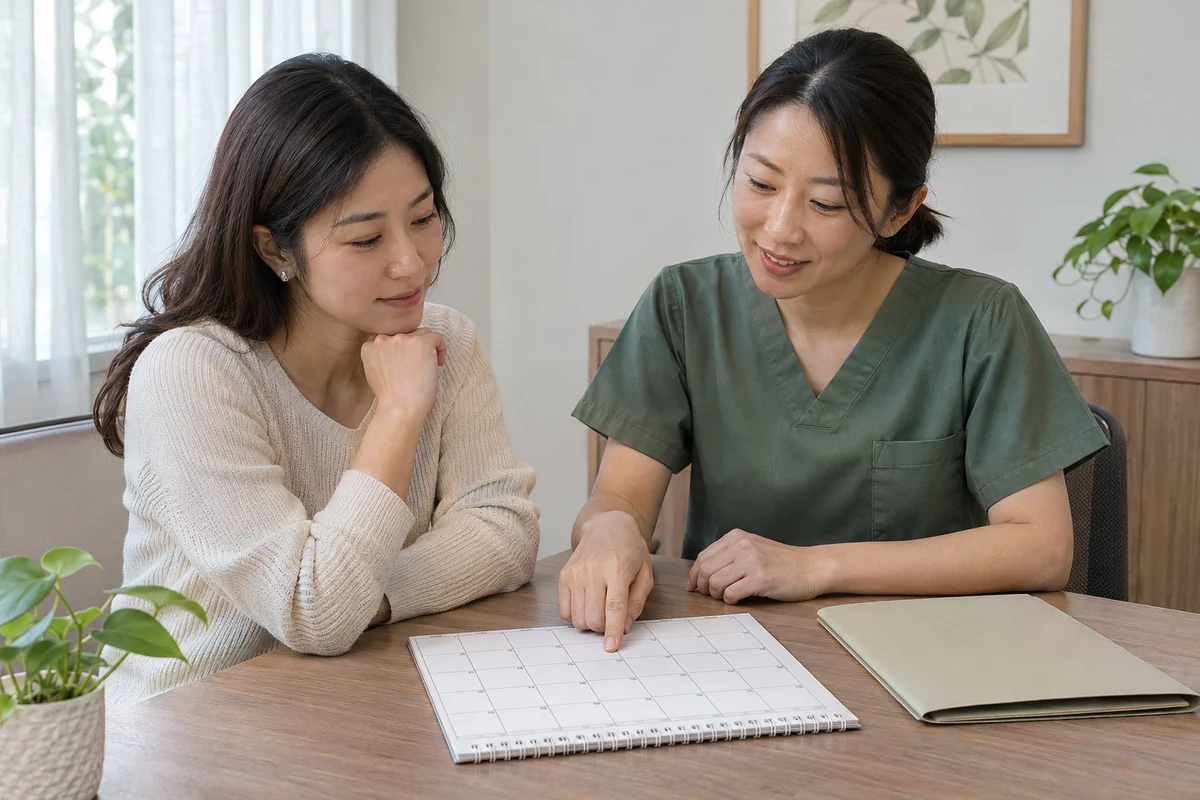
Start with the experience you want to discuss. You might be finding the appointments stressful, noticing an accompanying pain concern or wanting to understand what needling involves before deciding whether to try it. Name that concern separately from the reproductive outcome. This helps the practitioner explain what the service is intended to address and how its usefulness could be reviewed.
The American Society for Reproductive Medicine’s patient information describes coping strategies during fertility treatment, including acupuncture among options people consider. The supportive goal is your wellbeing during care.
A goal can be simple and personal: being comfortable during an appointment, discussing a recurring muscle-pain problem or making room for a manageable supportive-care routine. Explain what would make the extra appointment worthwhile to you. There is no obligation to add it if the travel, timing or appointment demands would create more strain.
Understand pregnancy, implantation and live birth as different outcomes
A positive test, an ultrasound-confirmed pregnancy and a live birth refer to different stages. Likewise, feeling calmer after a session is a different observation from an improvement in a reproductive outcome. Keeping these questions separate makes a consultation more useful and helps avoid promises that go beyond what the service can deliver.
ASRM’s 2017 embryo-transfer guideline concluded that acupuncture around transfer did not improve live-birth rates. In a 2018 randomized trial at 16 Australian and New Zealand centers, 848 women were assigned to acupuncture or nonpenetrating sham treatment during a fresh IVF cycle: one session during stimulation and two around transfer. Among women with live-birth data, 74/405 (18.3%) in the acupuncture group and 72/404 (17.8%) in the sham group had a live birth, a difference that was not statistically significant. This tested that protocol, not every possible longer course.
A July 2026 review of 42 trials involving 9,390 women pooled manual acupuncture, electroacupuncture and transcutaneous electrical acupoint stimulation studies. It found higher pooled clinical-pregnancy and implantation rates, but an uncertain overall live-birth effect. The review combined different protocols and comparators. Its timing and session-number models were exploratory, not prescriptions. An early pregnancy signal should therefore not be presented as a proven increase in the chance of delivering a living baby or as proof that a three-month course is necessary.
A proposed effect on ovarian blood flow, hormones or the uterine lining is a mechanism question, not a live-birth result. Feeling calmer is another outcome. The appointment’s purpose should identify the actual goal, the evidence relevant to it and when it will be reviewed; it should not combine these different outcomes into one success claim.
When should you start acupuncture before IVF?
If you plan to use acupuncture as supportive care during IVF and your fertility timetable allows, consider starting about three months before the planned embryo transfer. Beginning earlier gives time to assess your concerns, observe your response and adjust a manageable care routine before the busiest part of the cycle.
In practice, that preparation period can include reviewing sleep, stress-related discomfort or a separate pain concern, explaining the proposed needling and coordinating visits with the reproductive team. A TCM assessment may add a traditional explanation of symptoms and menstrual history, as outlined below. It does not measure ovarian reserve, embryo quality or reproductive hormones.
The three-month window is a planning option, not a required biological reset or a promise of improved implantation. Do not postpone a recommended IVF cycle or alter medicines to complete it. If transfer is sooner, supportive care can still be considered around the actual medical schedule.
How does TCM reasoning fit an active IVF cycle?
In the traditional Kidney–Tian Gui–Chong/Ren–uterus framework (Chinese), the Kidney system describes a foundation for growth and reproduction. Tian Gui is the traditional reproductive factor associated with sufficient Kidney essence and Qi that enables reproductive maturation; Chong and Ren describe traditional pathways that regulate and supply reproductive function. These are connected ideas within TCM, not names for the kidneys, a particular hormone or ultrasound findings.
HKBU’s clinical teaching (Chinese) groups common fertility presentations as Kidney deficiency, Liver constraint, Phlegm-Damp and blood stasis. The practitioner considers menstrual history before IVF, current symptoms, tongue and pulse together. During medicated IVF, the calendar and hormone-related changes must also be considered; one symptom or a drug-controlled bleed cannot identify a pattern on its own.
- Kidney deficiency concerns insufficient traditional reproductive support. Qi weakness, Yin depletion and Yang weakness lead to different goals: strengthening support, nourishing, or warming. For example, dryness and heat sensations differ from cold limbs and a cold lower abdomen. A hospital teaching account (Chinese) explains these distinctions; they do not diagnose low ovarian reserve.
- Liver constraint describes impaired traditional movement of Qi; variable cycles, distension or breast discomfort may be relevant before treatment. The goal is to ease that constraint. Ordinary worry is not proof that a person caused infertility.
- Phlegm-Damp describes impaired handling of fluids within TCM, with features such as heavier discharge or a greasy tongue coating considered in context. The traditional goal is to improve that function and resolve Dampness, not to remove literal mucus from the fallopian tubes or diagnose from body size.
- Blood stasis may involve menstrual pain, dark or purplish bleeding and clots; the traditional goal is to regulate movement of Qi and Blood. CUHK’s teaching (Chinese) discusses these features. This is not a diagnosis of a blood clot, nor permission to use blood-moving herbs during transfer or pregnancy.
Patterns can overlap: reduced support may coexist with constraint, Dampness or stasis. The aim is to explain which findings matter and why the proposed care addresses them, then reassess as symptoms, medicines or the IVF stage change. A natural-cycle phase model is not an automatic point or herbal schedule for a medicated cycle. Our TCM fertility consultation guide explains the broader pattern assessment; IVF monitoring and medicine decisions remain with the reproductive team.
Make a plan around the fertility clinic's calendar
Bring the dates you currently know and distinguish confirmed appointments from estimates. Include monitoring, retrieval, transfer and scheduled follow-up. If the cycle changes, update the acupuncture office before arranging a new time. The aim is a schedule that respects the reproductive team's instructions and your available energy.
Do not build a tight sequence that depends on every appointment starting and finishing exactly on time. Then discuss whether an optional visit fits comfortably around those requirements. A missed complementary appointment should not become a reason to compromise the medical plan.
For the broader context of trying to conceive, our fertility-support acupuncture guide covers evaluation timing, needle-placement questions, treatment frequency and appointment planning. This IVF guide concentrates on coordinating an appointment with an active assisted-reproduction cycle.
Before stimulation: prepare a concise care summary
A short summary can prevent repeated explanations. Bring your diagnosis if known, relevant reports you already have, current medicines and supplements, and the concern you want to discuss. Note any restrictions or specific instructions from the fertility team. You do not need to obtain extra tests solely to create an acupuncture appointment summary.
Follicles are fluid-filled sacs containing eggs. During stimulation, the fertility team follows their development with ultrasound and blood estradiol measurements and adjusts medicines when needed. The endometrium is the uterine lining; its preparation and the timing of progesterone support belong to the fertility protocol. SART’s IVF guide explains these steps. Endometrial receptivity means the lining’s ability to support implantation at the appropriate time; it is not the same as one thickness reading. An acupuncture sensation or change in menstrual appearance cannot establish better follicle development, egg quality or receptivity. Any such claim needs a measured reproductive outcome, not an inference from relaxation.
Separate a confirmed finding from a question still being investigated. For example, a report may contain a result that your reproductive clinician has not yet explained.
Also mention practical concerns such as needle anxiety, difficulty lying in one position or a long commute. These can affect whether and how an appointment is arranged. Good preparation includes your preferences, not just the medical paperwork.
During stimulation: keep medication decisions with the fertility team
Tell the practitioner which medicines you are taking and when the regimen changes. Include prescribed anticoagulants and nonprescription products. Do not change a dose, skip an injection or alter a medication schedule to accommodate needling.
New symptoms during a cycle should be reported through the fertility clinic’s instructions, with their onset and whether they are worsening. ASRM’s ovarian hyperstimulation syndrome information identifies increasing abdominal swelling, persistent vomiting, difficulty taking fluids, decreased urination and sudden abdominal pain as reasons to contact the treating team promptly. Trouble breathing or severe sudden pain warrants urgent medical care. Do not wait for a routine acupuncture appointment or assume these changes are ordinary tension.
When discussing comfort goals, be specific about what is happening and what has already been assessed. That allows a proposed supportive session to sit within the medical plan rather than treating every symptom as the same kind of tension.
Around retrieval and transfer: allow room for recovery
Confirm the fertility clinic's procedure and recovery instructions before making another appointment. Share those instructions with the practitioner. Your plan should follow your actual procedure, rather than a generic online timetable.
Transfer-day acupuncture is optional; the research above does not make it a required step for a successful transfer. If a visit would require rushed travel or reduce the time available for the fertility clinic’s instructions, arrange another time or leave it out. Our embryo-transfer acupuncture guide focuses on the immediate before-and-after timetable; this article covers the wider IVF cycle.
During the wait afterward, agree how you want to use your time and whom to contact with questions. Follow the reproductive team's testing schedule. An acupuncture sensation, a change in mood or a single day of symptoms cannot determine whether implantation has occurred, so do not use the session as a pregnancy test.
What happens at a first acupuncture appointment?
An initial Wongs Acupuncture & Angel Alliance Physical Therapy acupuncture visit is about 75–90 minutes. Bring your care summary and explain your main goal before treatment. Discuss which body areas would be used, how you would be positioned, what sensations to expect and how to request a pause. Tell the practitioner if you prefer a more gradual explanation before deciding.
The NIH NCCIH acupuncture overview describes thin needles inserted through the skin and safety with trained practice and sterile, single-use needles. Brief insertion discomfort, aching or bruising can occur; sharp or continuing pain should be reported so the session can be adjusted or stopped. The practitioner reviews medicines, implanted devices and possible pregnancy and explains body areas and positioning. General procedure information does not prescribe a fertility-specific point map.
You can ask questions, request an adjustment or decline a proposed part of care. For more about the general experience, see our first-visit guide.
Do fertility-support needles have to go in a particular place?
Point selection is individualized to the practitioner's assessment and proposed goal. An online list of abdominal, hand or leg points is not a personal treatment plan and should not be used as a self-needling guide.
Tell the practitioner about the current cycle stage, recent procedures and possible or confirmed pregnancy before each appointment. If the fertility team has given restrictions, share the actual instructions. The relevant question is whether the proposed session fits your current situation, rather than whether it matches a diagram someone else used.
Keep herbal products and supplements a separate decision
An acupuncture visit does not automatically include or require herbal products. Before adding a product, show the fertility team its name, ingredients and dose. The NIH NCCIH supplement guide explains medicine interactions and pregnancy-related precautions. A natural label does not establish compatibility with your IVF regimen.
If you already use a preparation, include it in the same medication list as your prescriptions. Do not rely on a general fertility-support label or a previous cycle's instructions as approval for the current cycle. Our herbal consultation page describes a separate service.
How many appointments should you plan?
There is no universal number of visits that guarantees pregnancy. A manageable plan should account for your goal, cycle calendar, travel, available time and preferences, and it should be open to adjustment as those circumstances change.
At review, return to the goal you chose. Was an accompanying symptom easier to manage? Was the appointment comfortable and worthwhile? Did the extra visit fit your week? Discuss unwanted effects and practical difficulties as well as useful changes. This helps you decide whether to continue without turning every appointment into a test of how hard you are trying to conceive.
Support wellbeing without blaming yourself
A 2019 report of secondary outcomes from the same IVF trial found a small reduction in anxiety after transfer in the adjusted analysis compared with sham acupuncture. Overall quality of life did not differ between groups, and a general-health improvement in one analysis was not sustained at 14 weeks. This supports discussing a possible short-term anxiety goal separately from reproductive success, without promising that everyone will feel better.
The ASRM stress-and-infertility resource supports coping strategies and distinguishes feeling better from achieving pregnancy. You do not have to eliminate ordinary worry to deserve care or to approach treatment correctly.
Choose support that fits you. That may include a quiet appointment, time with someone you trust or another resource discussed with the fertility team. Persistent distress, substantial sleep difficulty or low mood deserves appropriate professional attention in its own right. Supportive care should reduce the burden of treatment, not add another standard you must meet.
How the additional visit fits IVF care
An IVF-related acupuncture appointment has a defined comfort or accompanying-symptom goal and a review point. Its timing follows the fertility center’s current procedure dates and instructions. The initial visit, follow-up and schedule-change arrangements are explained by the selected office. New symptoms during the IVF cycle are reported to the fertility team as appropriate.
Planning a Wongs Acupuncture & Angel Alliance Physical Therapy consultation
Our acupuncture service is available in Manhattan, Forest Hills and Great Neck. Tell the selected office that you are receiving IVF care, explain your current stage and allow about 75–90 minutes for an initial appointment. Confirm the practitioner, timing and any follow-up separately.
Find the guide for your stage
Choose the guide that matches where you are in care. Each covers a different decision or part of the treatment calendar.