
HEALTH JOURNAL
TCM and Fertility: Understanding the Consultation’s Role
Ben Wong · · Updated
A traditional Chinese medicine fertility consultation uses menstrual history, symptoms, sleep, digestion and other observations to explain an individual pattern and a proposed care plan. It can address an accompanying concern such as menstrual discomfort while reproductive testing and treatment continue on their own timetable. Acupuncture and herbal products are separate choices, each with its own purpose and safety review.
TCM fertility consultation is different from a promise to conceive. It brings a traditional framework to the discussion of your experience, while reproductive clinicians investigate ovulation, sperm, the uterus and fallopian tubes and direct any fertility treatment. Understanding these roles makes it easier to choose supportive care confidently and keep important decisions moving.
On this page
- Begin with your current stage of fertility care
- Keep reproductive evaluation on schedule
- What a traditional pattern discussion involves
- Build a useful cycle history
- Bring reports without turning one number into the whole story
- Choose a supportive goal that you can recognize
- Decide about acupuncture and herbs separately
- Make the medication conversation specific
- Coordinate around treatment dates
- Support wellbeing without adding blame
- Use follow-up to make the next decision clearer
- Decide what information to share between visits
- Understanding the care plan
- Planning a Wongs Acupuncture & Angel Alliance Physical Therapy consultation
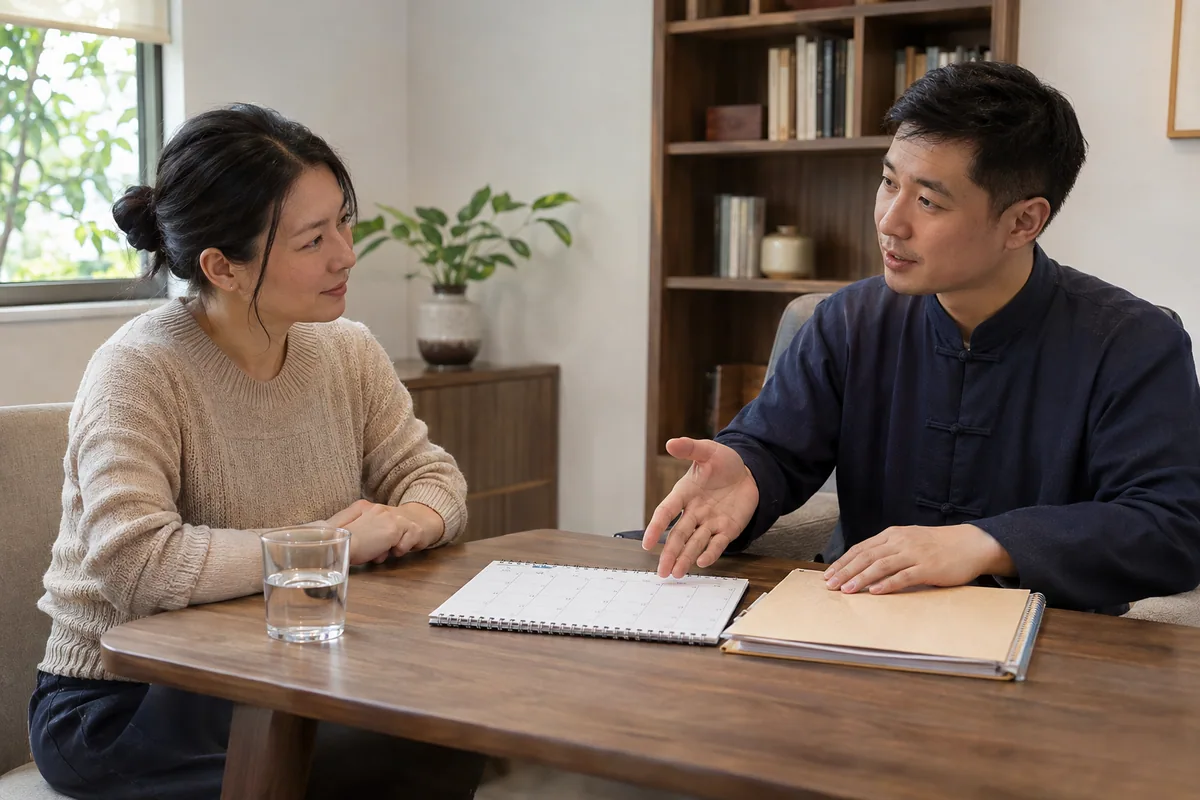
Begin with your current stage of fertility care
Tell the practitioner whether you are planning a pregnancy, trying without assisted reproduction, completing an evaluation or receiving treatment such as IUI or IVF. Explain what is already known and which questions remain open. Someone preparing for a first reproductive assessment has different coordination needs from someone waiting for a transfer date.
Bring the timeline in a practical format: when you began trying, meaningful changes in your cycles, previous pregnancies and the dates of any upcoming procedures. Include your reproductive clinician's instructions. A short, accurate account is more useful than trying to supply a complete explanation for every symptom before you have been assessed.
Keep reproductive evaluation on schedule
The American Society for Reproductive Medicine's fertility-evaluation guidance describes when testing is appropriate. In the absence of reasons for earlier investigation, evaluation generally begins after 12 months of trying below age 35 and after six months at 35 or older. Above 40, more immediate evaluation may be appropriate. Known risk factors can justify earlier care.
When a male partner contributes to the pregnancy, both partners' histories and evaluation matter and their evaluation should begin at the same time. A consultation focused on one person's menstrual symptoms should not make the other partner's assessment disappear.
What a traditional pattern discussion involves
In TCM, a pattern connects several observations rather than naming a single cause of infertility. The practitioner considers the menstrual cycle, discomfort, temperature preferences, sleep and digestion together. Qi describes functional activity in this traditional framework; blood refers to nourishment as well as circulation, while Yin and Yang describe related nourishing and warming functions. These concepts are not hormone measurements or substitutes for reproductive testing.
The traditional Kidney system includes ideas about development and reproduction. A Kidney pattern does not mean anatomical kidney disease, and it does not measure ovarian reserve. The following distinctions explain common lines of reasoning in Chinese professional sources; they are not a checklist for diagnosing yourself.
Kidney deficiency: why warming and nourishing are different goals
Kidney Qi deficiency describes inadequate support for reproductive functions within TCM theory. Kidney Yang deficiency emphasizes reduced warming: a later or scantier period together with feeling cold, lower-back soreness or a cold sensation in the lower abdomen may lead to that discussion. The traditional goal is to support warming and the menstrual pattern, rather than simply apply the same warming approach to every person trying to conceive.
Kidney Yin deficiency emphasizes reduced nourishment and moistening. Scanty or absent periods accompanied by dryness, warmth in the palms or soles, dizziness or lower-back weakness suggest a different traditional explanation. The proposed approach emphasizes nourishment rather than extra warming. One symptom alone cannot establish either pattern, and neither term identifies an egg count or egg quality.
Liver Qi constraint: a changing, distending pattern
In TCM, the Liver system is associated with the smooth movement of Qi and blood. Variable cycles, breast or lower-abdominal distension before a period, and symptoms that fluctuate with emotional strain may be considered together. The treatment principle called soothing the Liver means addressing this constrained pattern; it does not mean treating liver damage. Emotional strain is one observation, not an explanation that blames a person for infertility.
Phlegm-Damp: more than a description of body weight
This pattern describes a traditional problem with processing and moving fluids. The assessment may consider delayed or scanty periods alongside increased sticky discharge, a greasy mouth sensation or other digestive and fluid-related observations. Treatment reasoning emphasizes transforming Dampness and supporting those functions. The term does not mean that mucus has physically blocked a fallopian tube, and body size alone does not establish the pattern.
Blood stasis: the character of pain and bleeding matters
Blood stasis describes impaired movement within the traditional framework. Menstrual pain, darker or purplish bleeding, and clots may be considered together in this pattern. These observations need context; a clot alone does not establish the diagnosis. The proposed principle is to improve that movement. It is not equivalent to a medical blood clot, proof of tubal blockage or permission to use a blood-moving herb during fertility treatment or pregnancy.
Patterns can overlap. Kidney deficiency may coexist with Liver constraint, Phlegm-Damp or blood stasis, so a plan may address both reduced support and a current obstructive pattern. The balance can change as symptoms, medicines or the fertility-treatment stage change. Follow-up therefore returns to the original observations and the reproductive team's findings; a more regular period or less discomfort does not by itself establish conception or restored ovarian reserve.
These explanations draw on Hong Kong Baptist University's discussion of fertility patterns (Chinese), Quanzhou Hospital of TCM's pattern distinctions (Chinese) and People's Medical Publishing House's traditional explanatory framework (Chinese). The Chinese University of Hong Kong's pattern explanation (Chinese) also describes differences in bleeding and pain. These sources describe TCM reasoning, not measured pregnancy benefits.
Build a useful cycle history
Bring the start dates of recent periods and describe changes you have noticed. Include unusually heavy bleeding, bleeding between periods, substantial pain or long gaps between cycles. Note whether a symptom is new, recurring or already assessed. You do not need a sophisticated tracking app; a calendar and a few plain-language notes can be enough to prepare the conversation.
Explain how symptoms affect daily life. Missing work because of pain, repeatedly waking at night or finding intercourse painful are more informative than saying your cycle feels unbalanced. These observations help identify what deserves medical investigation, what has already been diagnosed and what accompanying concern you want to discuss in a supportive-care visit.
Bring reports without turning one number into the whole story
If testing has been completed, bring the reports and the reproductive clinician's interpretation. Distinguish a confirmed diagnosis from a result you have not yet discussed. The same laboratory number can have different implications depending on age, history, the purpose of testing and other findings. The clinician responsible for the reproductive assessment interprets those results in context.
A traditional consultation should work with that information rather than supply an alternative test of tube openness, sperm function or embryo quality. Avoid treating a change in symptoms as a substitute for the measurements your clinician needs. Related information: AMH and ovarian-reserve guide.
Choose a supportive goal that you can recognize
Separate the goal of having a baby from an accompanying concern you can discuss directly. You may want help understanding a pain problem, planning a comfortable appointment or deciding whether a particular service fits your preferences. Name that concern before agreeing to a treatment schedule. This allows the proposed role to be explained and reviewed on its own terms.
Acupuncture or a herbal preparation should not be presented as an established way to increase live births or restore ovarian reserve. A useful consultation can still clarify choices and coordinate care. The plan should identify the specific concern, the support relevant to that goal and how the service fits your existing medical care.
Decide about acupuncture and herbs separately
An acupuncture appointment and a herbal consultation are separate decisions. Agreeing to discuss needling does not mean you must also take a preparation.
Our acupuncture service information describes the needling service. Our Chinese herbal consultation page describes a different pathway involving product and ingredient discussions. A formula name, an online fertility label or a recommendation from someone with a different diagnosis is not enough to establish your personal plan.
Make the medication conversation specific
Bring the names and doses of prescriptions, nonprescription medicines, vitamins and other products you already use. For a herbal preparation, bring the label or a clear photograph showing the ingredients and manufacturer. Explain when you started it and whether any symptoms changed. A complete list is more useful than saying you take something natural for fertility.
The HFEA information on complementary therapies advises checking with the fertility clinician because some products can interact with medicines or be unsuitable during pregnancy. Keep decisions about prescribed fertility medicines with the prescribing team, and check proposed additions before starting them.
Coordinate around treatment dates
Monitoring, retrieval and transfer dates may change during an IVF cycle. Tell the office which dates are confirmed and which are estimates. Share any instructions about recovery, positioning or other appointments. An optional visit should fit around those requirements and your available energy, rather than depend on rushing between offices.
There is no universal requirement to have acupuncture on transfer day or to begin a particular number of months in advance. If your schedule changes, contact the office to discuss arrangements. Our IVF appointment-planning guide covers those practical coordination questions in more detail, while your fertility team remains responsible for the medical cycle.
Support wellbeing without adding blame
Trying to conceive can affect relationships, work and the way you experience ordinary days. You may appreciate time to explain what has become difficult and choose a manageable form of support. You do not have to arrive calm, optimistic or completely organized to seek help.
The ASRM patient resource on stress and infertility discusses coping and quality of life separately from pregnancy outcomes. A stressful week is not a personal failure, and feeling relaxed after a session cannot determine whether conception has occurred. Seek appropriate mental-health support if distress becomes persistent or interferes substantially with daily life.
Use follow-up to make the next decision clearer
Before starting an optional service, agree on the initial purpose and a review point. At follow-up, return to the same concern: what changed, how long the change lasted and whether the plan remained manageable. Include unwanted effects, changes in medicines and updates from the reproductive team.
For example, if the goal involved a particular pain symptom, describe its frequency and impact on an ordinary activity. If the goal was a more comfortable appointment experience, say what made it easier or harder. These are discussion examples, not patient stories or promises. They help you evaluate the actual purpose without turning every visit into a forecast of pregnancy success.
Decide what information to share between visits
Keep one current summary for the practitioners involved in your care. Add a new reproductive diagnosis, a medicine change or a revised procedure date when it occurs. This avoids relying on a remembered conversation from an earlier stage of treatment.
Care coordination identifies the next step and the responsible clinician, with consistent instructions across the team.
Understanding the care plan
A traditional pattern is explained through the symptoms and history considered during the assessment. Reproductive diagnosis, testing and treatment remain with the reproductive clinician. Each additional service has a defined symptom or comfort goal; herbal products require ingredient and interaction review before a new treatment stage. Follow-up compares that goal and any unwanted effects to decide whether to continue, adjust or stop.
The consultation should make the available choices understandable and preserve timely reproductive evaluation and treatment.
Planning a Wongs Acupuncture & Angel Alliance Physical Therapy consultation
When contacting Wongs Acupuncture & Angel Alliance Physical Therapy, explain your fertility-care stage and the concern you want to discuss. Confirm the service, practitioner and appointment arrangements with the selected office. For general needling preparation, see our first-visit acupuncture guide.
OUR LOCATIONS
Choose a clinic.
Choose a convenient location to discuss your needs or arrange a visit.